

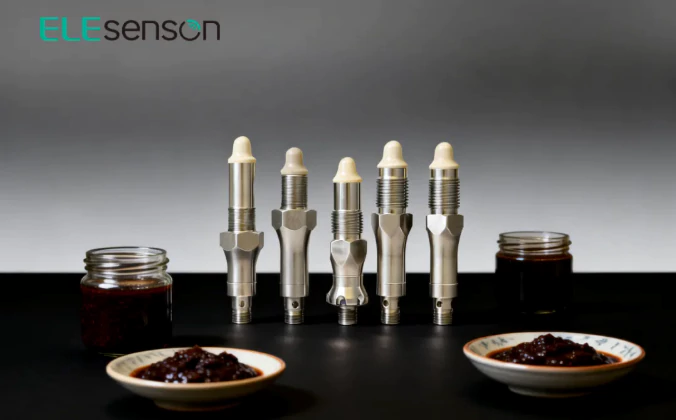
RF Admittance Level Sensor | Anti-Sticking Detection for High-Viscosity Food Sauces
In industrial storage tanks and reaction vessels handling viscous media such as adhesives, resins, asphalt, industrial coatings, and food sauces, traditional level detection faces a stubborn and long-standing pain point: false level alarms caused by probe adhesion and material residue. Unlike conventional liquid materials, high-viscosity substances easily cling to sensor probes and form a persistent coating layer. This common issue leads traditional capacitive level sensors to generate distorted data: the system displays a “full tank” status even when the tank still has vacant space, or continues to show “material present” after the tank is completely emptied. These frequent false readings trigger unplanned production shutdowns, mandatory manual tank and probe cleaning, material overflow accidents, and massive raw material waste, severely disrupting automated production stability and increasing operational costs.
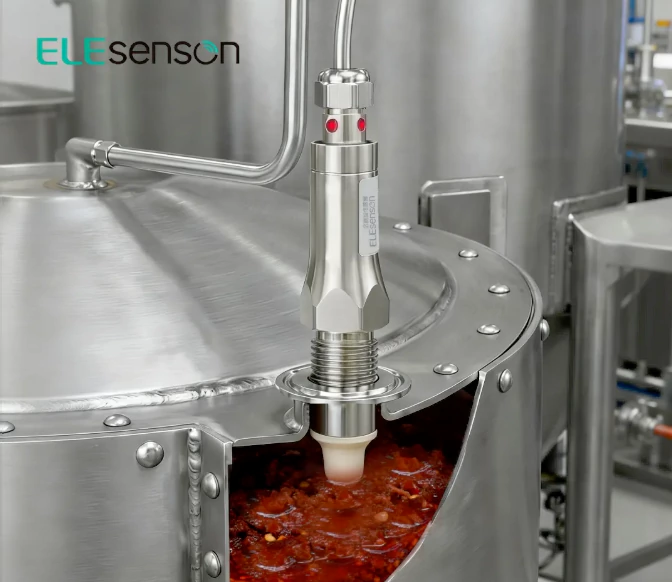
ELE industrial RF admittance level sensor adopts proprietary RF admittance detection technology and innovative active shielding structure, thoroughly solving the false detection dilemma caused by viscous medium adhesion. It delivers stable, drift-free, and high-precision level monitoring for all high-viscosity, easy-adhesion working conditions, putting an end to inaccurate detection of traditional capacitive sensors.
01
Core Advantage: True Anti-Sticking & Anti-Clogging Sensing
The fundamental defect of traditional capacitive sensors is single-dimensional detection logic. Such sensors only judge the material level by capacitance value changes, failing to distinguish betweenactual medium contact and residual adhesion layer. Since both real materials and sticky residues can alter capacitance data, false alarms are inevitable in viscous medium working scenarios.
ELE RF admittance level sensor realizes disruptive upgrading through multi-dimensional RF admittance detection + equipotential active shielding electrode design. The probe adopts a dual-electrode synchronous operation structure, in which the measuring electrode and the shielding electrode maintain completely consistent potential, frequency, and phase. The system actively eliminates the interference signal generated by the surface adhesion layer, achieving exclusive identification of real material coverage at the probe tip.
No matter how strong the medium viscosity or how thick the surface adhesion layer is, the sensor output signal remains stable and accurate without drift or misjudgment. In short, probe adhesion will never interfere with effective detection — sticky residue cannot fool ELE’s professional sensing algorithm.
02
Technical Principle: Break Through Detection Limitations, See Through False Adhesion
2.1 From Single-Parameter Judgment to Multi-Dimensional Stereoscopic Detection
Traditional capacitive sensors rely solely on capacitance changes for level judgment, equivalent to “monocular observation” with a single judgment dimension. Once the probe is covered by sticky materials, the capacitance data is disordered, resulting in a sharp rise in false detection rate.
ELE RF admittance technology achieves comprehensive stereoscopic detection. It synchronously collects and analyzes three core parameters: resistance (conductance), capacitance (admittance), and phase angle difference. By comparing the comprehensive characteristic differences between real medium contact and surface residue adhesion, the system accurately filters invalid interference signals from sticky coatings and locks real material level changes. This upgrades detection from single-data judgment to full-feature material identification, fundamentally solving the adhesion interference problem.
2.2 Active Equipotential Shielding Technology: Zero Interference from Adhesion Layer
As the core black technology of anti-sticking detection, active driven shielding technology completely subverts the single-electrode structure of traditional sensors. The ELE sensor probe adopts a three-terminal integrated structure, including a central measuring electrode, a coaxial shielding electrode, and a driving terminal.
The measuring electrode and the shielding electrode transmit high-frequency RF signals synchronously with equal potential and identical phase. Since there is no potential difference between the two electrodes, the adhered sticky medium cannot form effective current conduction, and the adhesion layer loses all interference impact on measurement data. This realizes the professional detection logic of adhesion accumulates on the probe, while measurement remains completely accurate.
Meanwhile, the synchronous in-phase shielding layer forms a stable electrostatic isolation barrier, which shields external environmental interference and residual capacitance influence, focusing all detection accuracy on the real material level changes inside the tank.

03
Industrial Verification: Powerful Data Proves Stable Performance
3.1 Ultra-Low False Alarm Rate, Far Exceeding Traditional Sensors
In professional laboratory tests targeting high-viscosity asphalt medium (viscosity up to 5000 mPa·s), the ELE RF admittance level sensor achieves afalse alarm rate lower than 0.1%, with less than one misjudgment in 1000 detection cycles. In contrast, traditional capacitive sensors have a false alarm rate as high as 20%–30% under the same working conditions, unable to meet continuous and stable production requirements.
3.2 Greatly Improved Detection Accuracy, Reducing Material Waste
A large chemical plant’s adhesive and resin storage tanks once suffered from overflow losses caused by low detection accuracy. Traditional transmitters had a measurement error of ±5%, leading to frequent material overflow and raw material waste. After replacing with ELE RF admittance level sensors, the detection error was optimized to ±0.5%, reducing annual raw material loss by more than 1 million RMB and effectively improving production benefits.
3.3 70%+ Reduction in Maintenance Downtime
For cement plant pulverized coal silos and damp powder storage equipment, traditional sensors require weekly shutdown cleaning due to easy adhesion of damp materials. After adopting ELE RF admittance sensors, the shutdown frequency caused by adhesion false alarms is reduced by more than 70%. It eliminates frequent manual cleaning and equipment downtime, realizing long-term unattended stable operation of the production line.
04
Product Core Features & Industrial Advantages
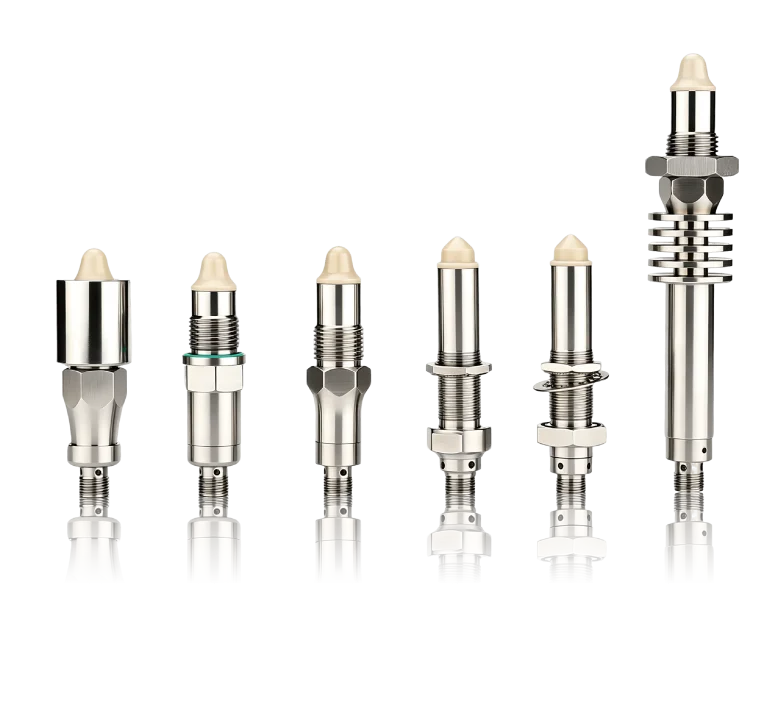
Relying on years of industrial sensor R&D and manufacturing experience, ELE specially designs RF admittance level sensors for high-viscosity, easy-adhesion, and harsh industrial media, covering chemical, food, building materials, and environmental protection industries.
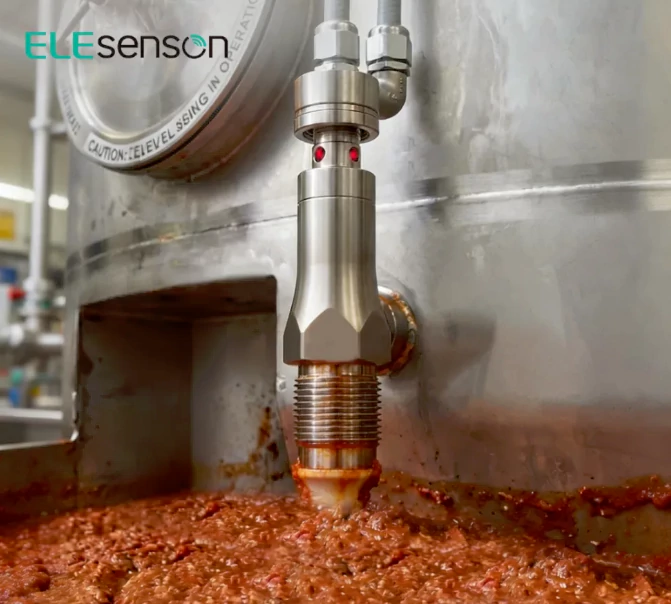
- Industry-Leading Anti-Adhesion Performance: Combining multi-dimensional admittance measurement and active shielding technology, it maintains accurate detection even when the probe is fully covered by sticky media, completely free from residue interference.
- Ultra-Wide Medium Compatibility: Applicable to all media with dielectric constant ≥1.6, including conductive liquid, non-conductive liquid, viscous slurry, asphalt, ink, glue, and food sauce, with strong scene adaptability.
- Maintenance-Free Electronic Design: No mechanical moving parts, zero mechanical wear, no need for regular manual probe cleaning, greatly reducing later operation and maintenance costs.
- Extreme Environmental Adaptability: Supports -40℃ to 200℃ wide temperature operation, withstands up to 10 MPa pressure, and features IP66/IP67 high-level protection, adapting to high-temperature, high-pressure, dusty, and humid harsh workshop environments.
- Intelligent & Easy Integration: Supports 4–20mA analog signal, digital switch output, and HART protocol. It can be seamlessly connected with PLC and DCS systems to realize automatic feeding, high/low level alarm, and intelligent inventory management.
05
Typical Industrial Application Scenarios
- Adhesive & Glue Storage Tanks: Realizes high and low liquid level alarm, tank overflow prevention, and empty pump protection to ensure safe and stable glue supply.
- Resin & Polymer Reaction Kettles: Continuously monitors material level changes during chemical reactions, supporting precise process control.
- Asphalt, Heavy Oil, Ink & Coating Tanks: Solves detection difficulties of high-temperature and high-viscosity media, avoiding false alarms caused by thick adhesion layers.
- Food Grade Sauce & Syrup Tanks: Provides stable and reliable level detection for viscous food materials, meeting sanitary production requirements.
06
Conclusion
For viscous medium production lines that are prone to adhesion and residue, level detection accuracy directly determines production safety, yield and maintenance cost. ELE RF admittance level sensor completely solves the industry pain point of adhesion false detection through active shielding technology and multi-dimensional sensing logic. It avoids material overflow, production shutdown and manual cleaning losses, becoming a reliable stable detection anchor for viscous medium industrial scenarios.
ELE RF Admittance Level Sensor: The Stickier the Medium, the More Accurate the Detection.
Contact ELE Sensor for free sample testing and professional technical selection support to customize exclusive level detection solutions for your working conditions.

elesenson
ELEsenson is a company specializing in the research, development, production, and sales of sensor technology, located in Wenzhou, Zhejiang, China. Upholding the corporate philosophy of “striving for perfection and pursuing excellence,” the company is committed to providing precise and reliable sensor solutions to customers worldwide. The company boasts an experienced R&D team dedicated to the research and development of cutting-edge sensor technologies. ELEsenon not only prioritizes product quality but also places a strong emphasis on customer needs. Production strictly adheres to international quality management system standards, ensuring that every product meets or exceeds customer expectations. Moving forward, Zhejiang ELEsenon will continue to pursue technological innovation and uphold the principle of quality first, striving to become a global leader in the sensor industry and providing customers with superior products and attentive service.