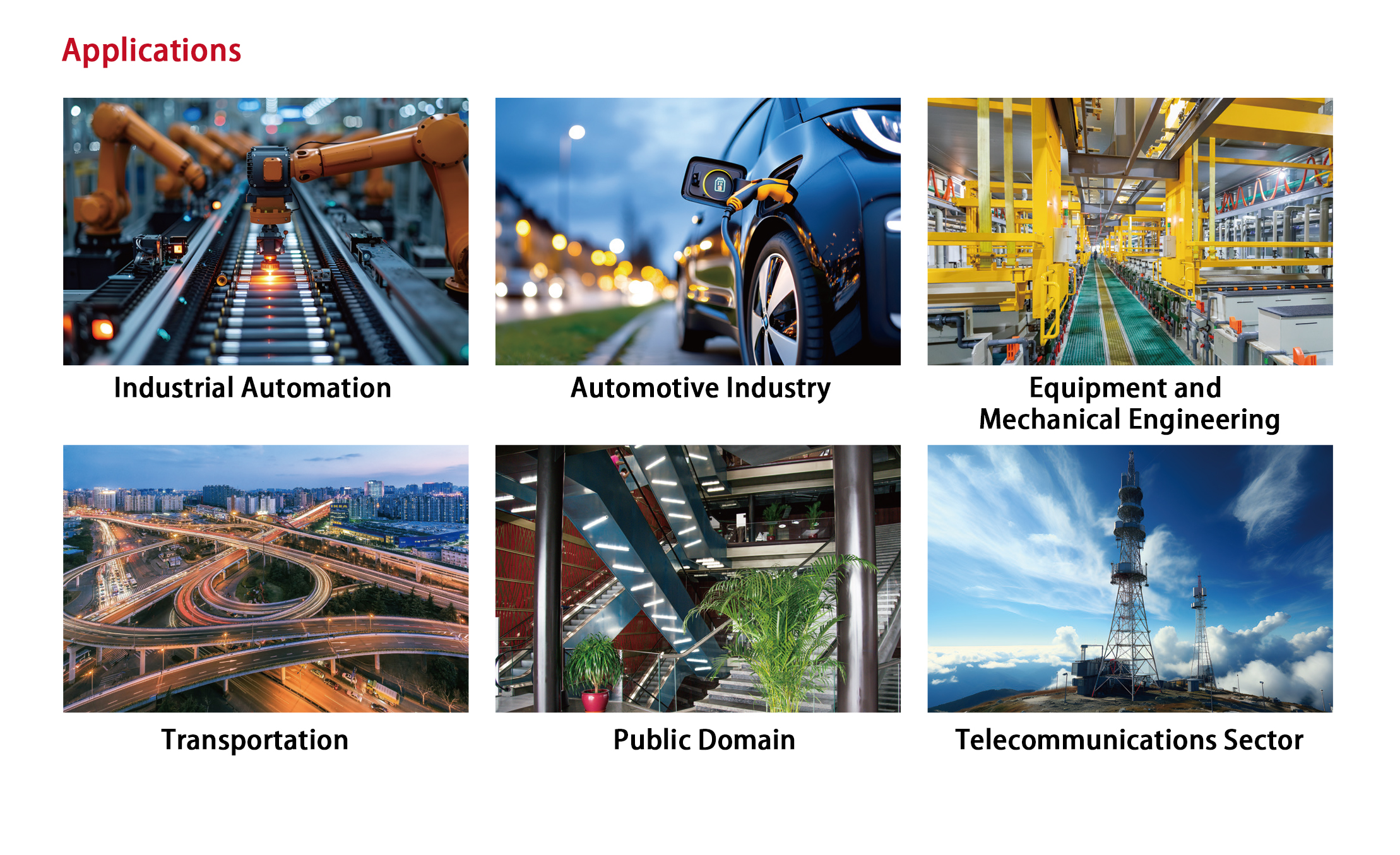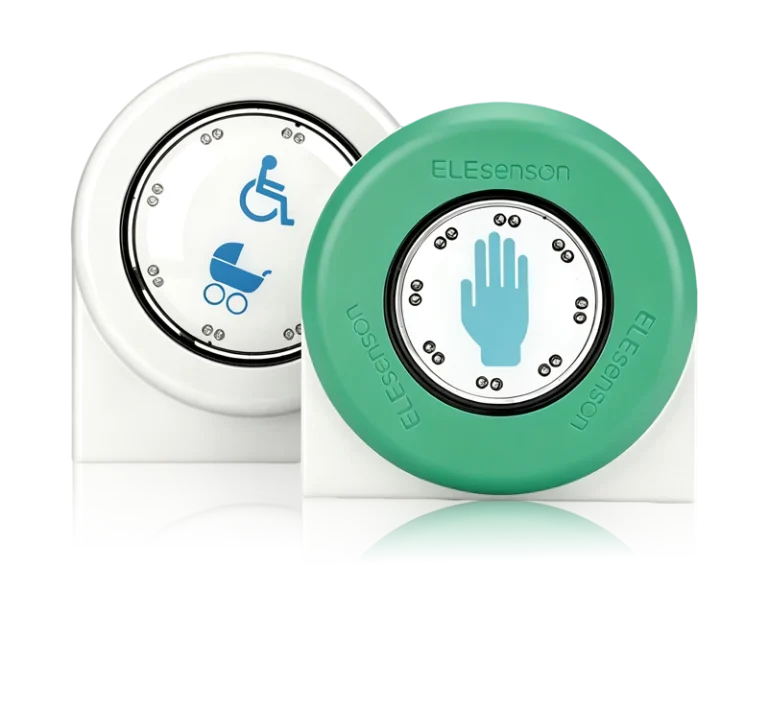
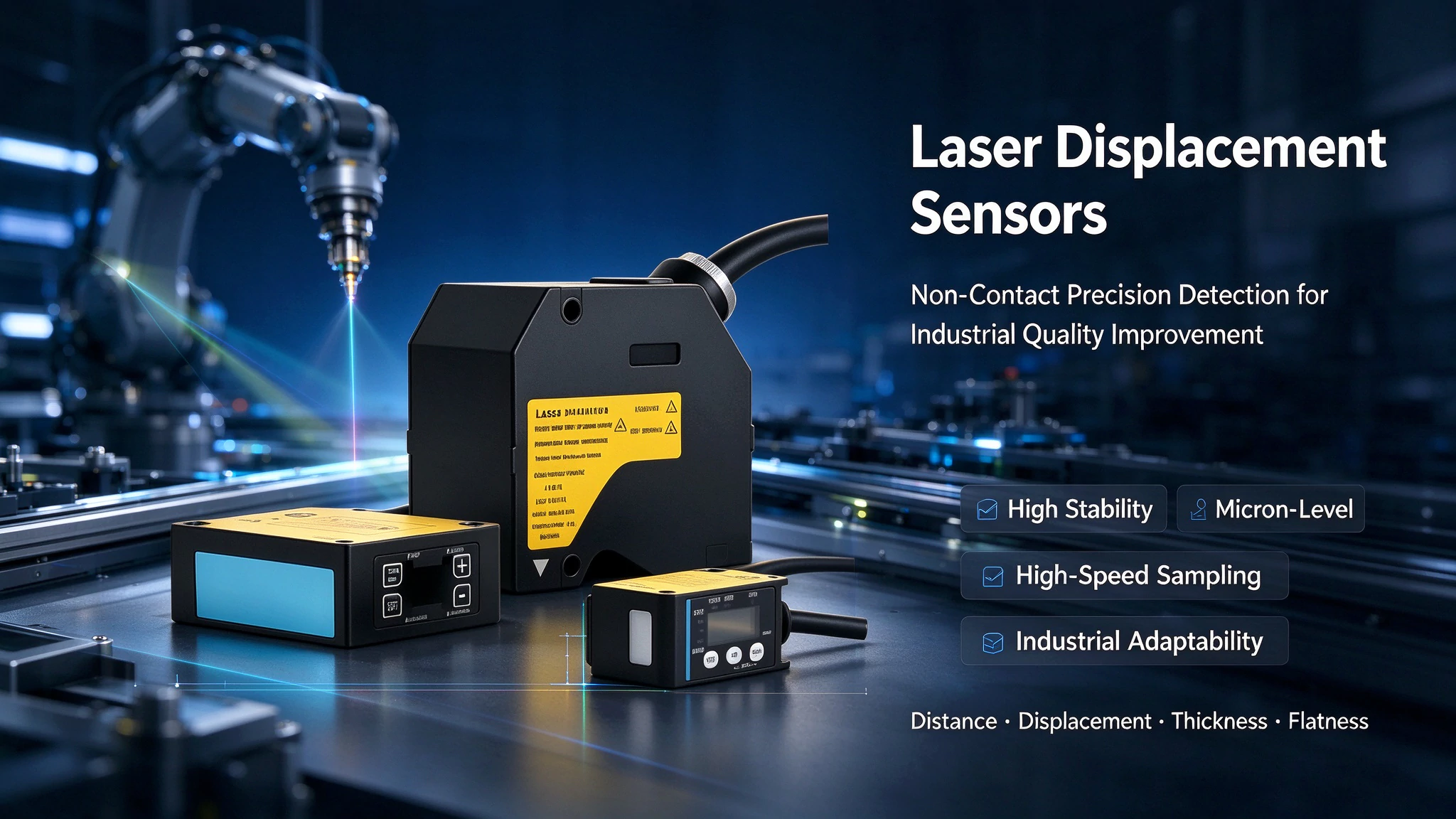
Laser Displacement Sensor | Non-Contact High-Precision Industrial Position Detection
With the continuous upgrading of intelligent manufacturing, non‑contact precision detection has become an indispensable core link for production line quality improvement and efficiency optimization. ELEsenson laser displacement sensors adopt mature laser triangulation principle to realize high‑stability collection of distance, displacement, thickness, and flatness data. As high‑performance industrial perception hardware, the sensors deliver reliable and repeatable measurement data for automated equipment, widely covering precision inspection, dimensional monitoring, and closed‑loop control scenarios in modern industrial production.
Non‑Contact & Damage‑Free Measurement
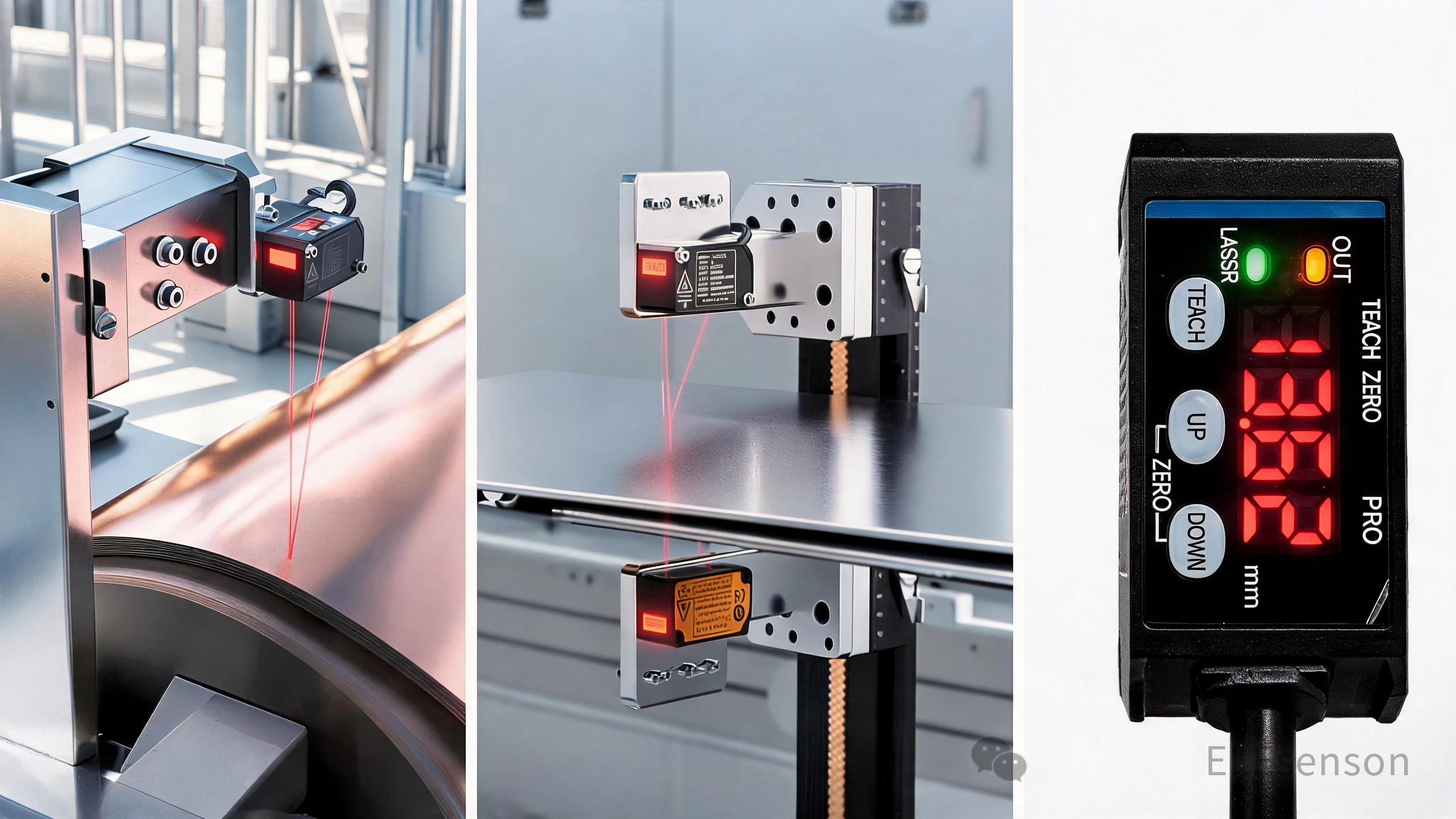
Adopting fully non‑contact laser detection mode, the sensor requires no physical contact with the workpiece surface. It completely avoids surface scratches, extrusion deformation, and contact detection errors. It is highly compatible with precision parts, flexible materials, and high‑gloss surfaces, supporting high‑speed dynamic online measurement with zero damage to workpieces.
High‑Precision & High‑Speed Dynamic Performance
Featuring stable micron‑level measurement accuracy, the sensor accurately captures tiny changes in height difference, thickness, flatness, deformation, and gaps. With ultra‑fast sampling response speed, it perfectly adapts to high‑frequency and high‑speed continuous operation of automated production lines, maintaining stable and consistent data output even in dynamic motion scenarios.
Strong Industrial Environmental Adaptability
Equipped with advanced anti‑ambient‑light interference algorithms, the sensor effectively resists complex light changes in workshop environments. The compact industrial‑grade structure tolerates industrial dust and slight oil pollution, ensuring long‑term stable operation. Supporting multiple standard signal outputs, it features simple installation and flexible debugging, enabling fast integration with various standard and non‑standard automated equipment.
Automated & Custom Non‑Standard Equipment
Widely used for workpiece positioning, height difference detection, and gap measurement on automated production lines. It assists robotic arms in precise picking and assembly, monitors real‑time fixture deformation, and provides accurate data support for equipment closed‑loop control, effectively improving assembly accuracy and production consistency.
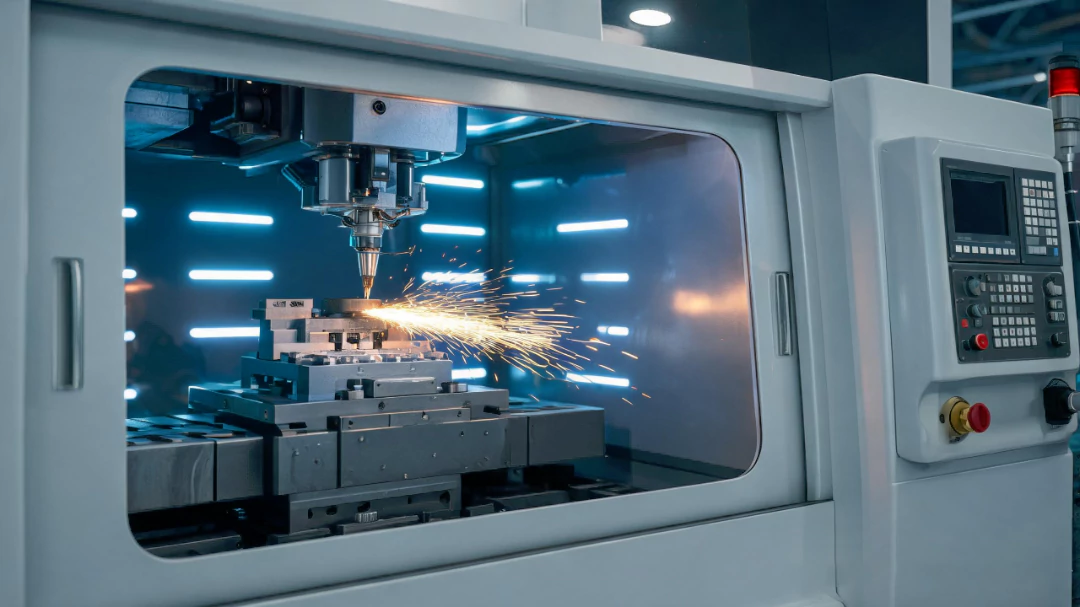
3C & Precision Component Manufacturing
Ideal for online quality inspection of electronic components, plastic parts, and hardware micro‑parts. It precisely detects product thickness, flatness, warpage deformation, and surface defects. It also monitors thickness fluctuation of flexible materials such as films and thin sheets, ensuring strict quality control for high‑precision miniature products.

Automotive Parts Industry
Applied for dimensional verification, flatness detection, and assembly gap calibration of automotive components. It dynamically monitors machining deformation and operational vibration displacement, providing reliable data support for product quality inspection, process optimization, and equipment operational condition monitoring in automotive manufacturing.

Metal Processing Industry
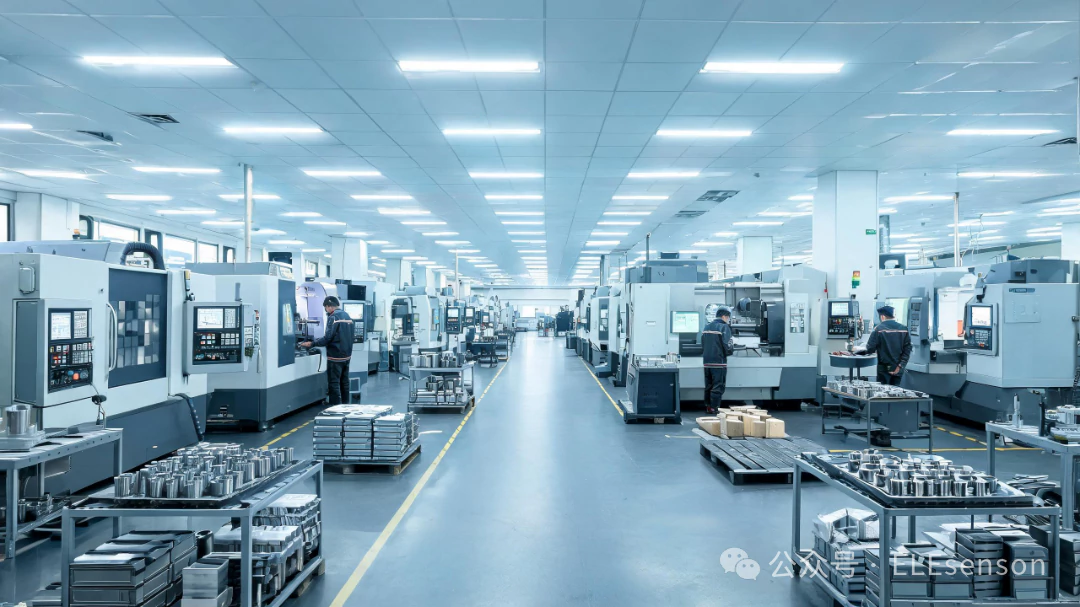
Suitable for thickness, flatness, and contour height detection of metal plates and profiles. It captures real‑time workpiece displacement changes during stamping, cutting, grinding, and other processing procedures, helping enterprises optimize processing parameters, improve machining accuracy, and increase finished product yield.
Logistics & Warehouse Automation
Easily integrated into intelligent warehousing and sorting equipment to realize cargo height detection, goods position positioning, and stacking state identification. It provides accurate spatial perception data for automated sorting and storage systems, ensuring efficient and stable operation of smart logistics scenarios.

Structural Monitoring & New Material Testing
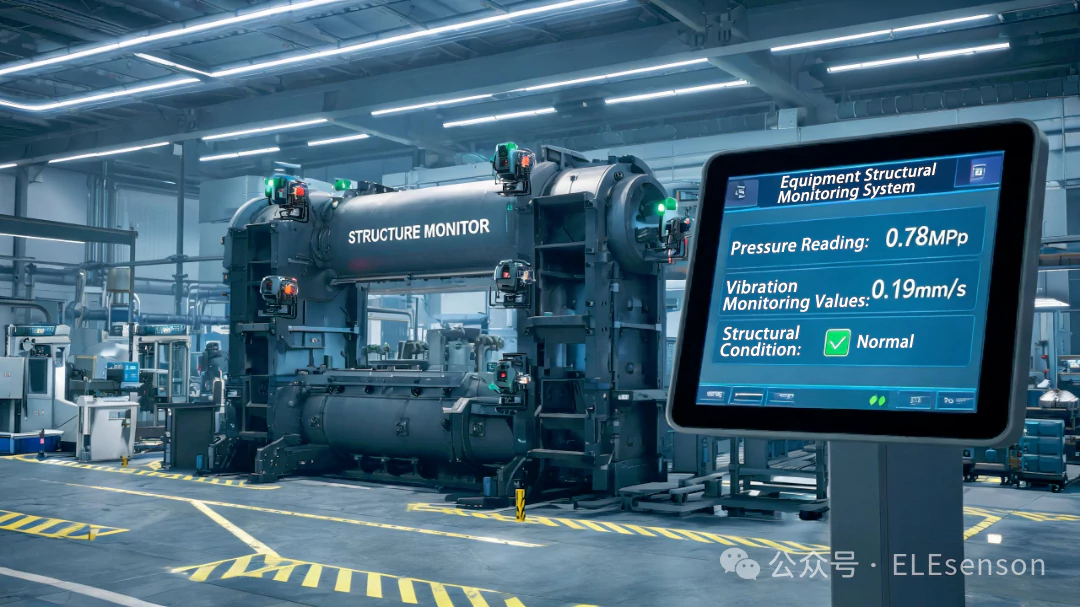
Capable of long‑term online monitoring of industrial equipment structural deformation and vibration amplitude, assisting equipment predictive maintenance and hidden danger troubleshooting. It also applies to deformation testing and performance analysis of new materials in laboratories, providing precise and repeatable measurement data for material research and process improvement.
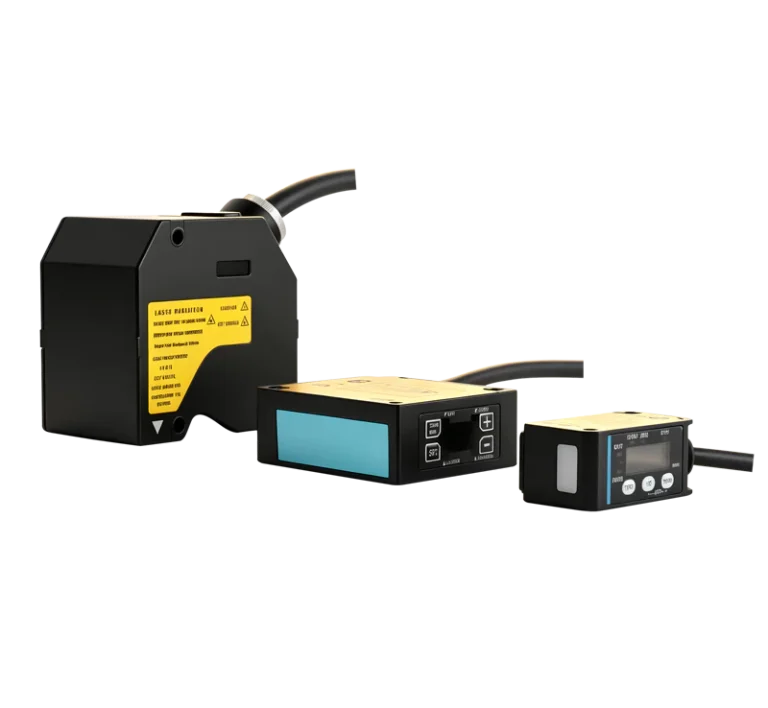
No manual measurement required — precise laser perception covers all detection needs. ELEsenson laser displacement sensors turn tiny distance changes into controllable, visible, and accurate data. With reliable industrial performance and all‑scenario adaptability, they bring stable precision and efficient intelligent detection to modern manufacturing.

Sweep Frequency Level Sensor for Jam Production | Food-Grade Detection
01.Jam Production Pain Points | Why Ordinary Level Sensors Fail
Jam production features highly viscous raw materials mixed with dense fruit pulp, which easily adheres to equipment surfaces. During stirring, boiling, and automated filling processes, materials frequently produce foam, steam, and turbulent liquid fluctuations. Conventional standard level sensors are unable to distinguish between residue buildup, foam interference, and real liquid level changes, resulting in frequent false alarms, signal instability, and inaccurate level feedback. These defects easily cause production interruptions, material overflow, equipment idling, and unstable batch quality, becoming a key bottleneck restricting automated and continuous jam production.

02.Working Principle | Intelligent RF Sweep Frequency Detection Technology
ELEsenson sweep frequency level sensor adopts advanced intelligent RF sweep frequency detection technology. It emits high-frequency variable sweep signals to monitor real-time changes in medium impedance and admittance. Equipped with self-developed intelligent algorithm logic, the sensor accurately identifies and distinguishes air, surface foam, probe residue, and real jam medium. It automatically filters various interference signals caused by viscosity, adhesion, and foaming, outputs stable and true level data, and supports real-time monitoring and full-process automatic control for jam production lines.
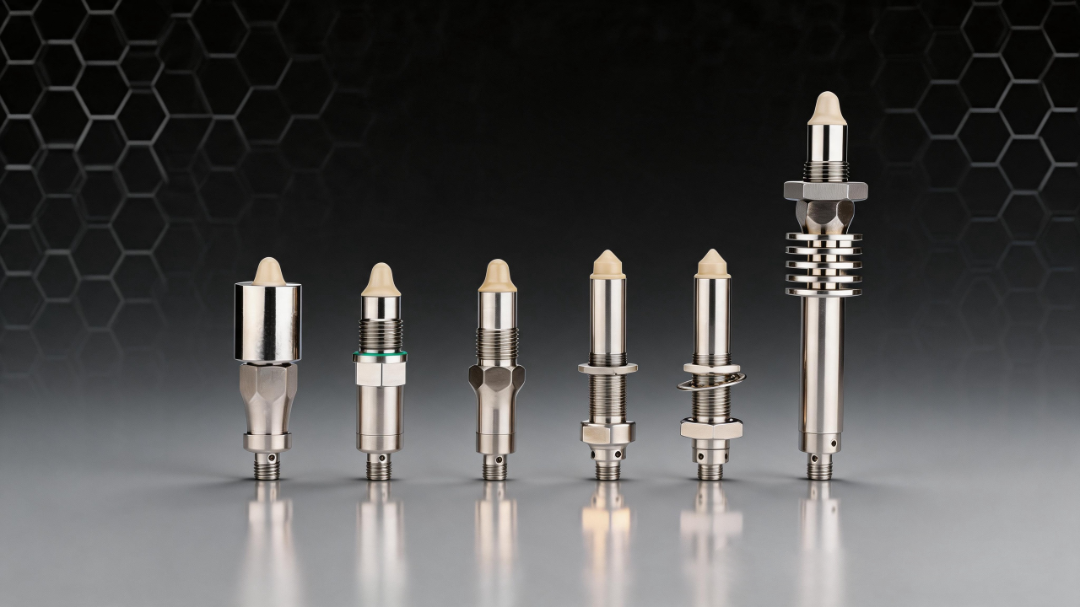
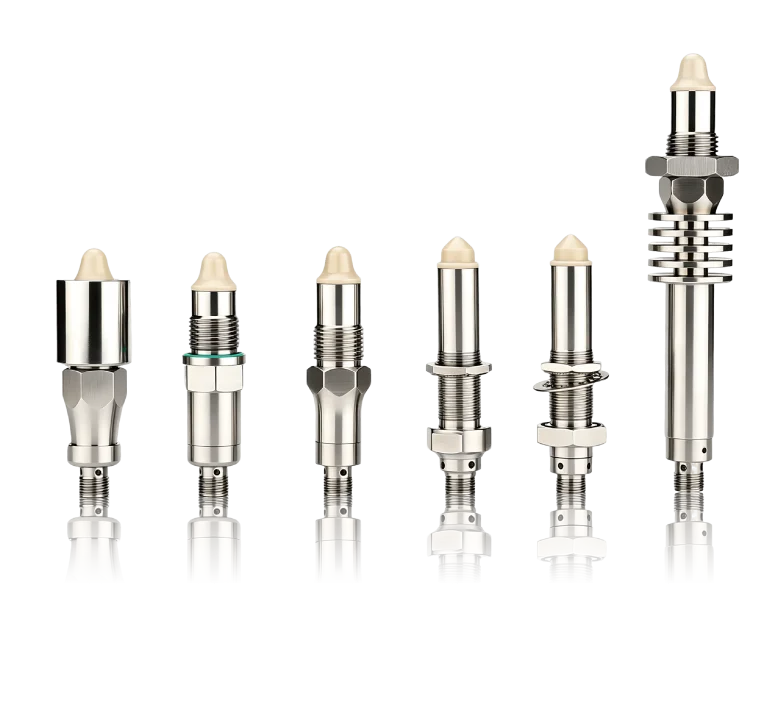
03.Core Advantages of Food-Grade Sweep Frequency Level Sensor
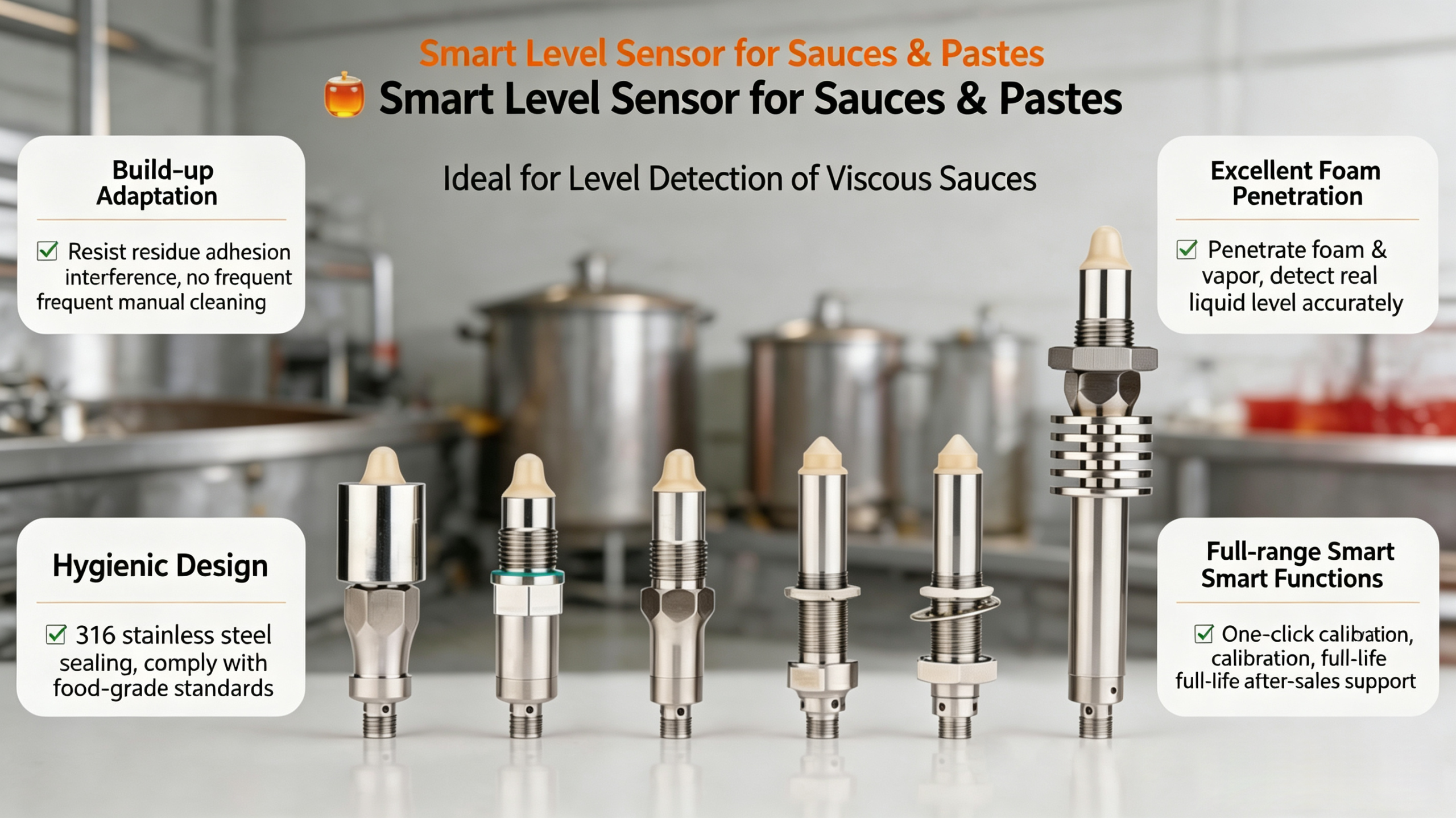
3.1 Adaptive Residue Suppression, Stable Detection Without False Alarms
Built with an adaptive residue suppression algorithm, the sensor effectively filters interference caused by thin sauce layers and pulp residue adhering to the probe surface. It only responds to real material level fluctuations and ignores static adhesion residue. It eliminates frequent manual cleaning work, completely solves the industry pain point of false alarms caused by viscous jam buildup, and ensures long-term stable and drift-free detection.
3.2 Strong Foam Penetration Capability, True & Accurate Liquid Level
Aiming at massive foam and steam generated during high-speed stirring and boiling of jam raw materials, the sensor features powerful foam penetration performance. It effectively ignores liquid surface turbulence and floating foam interference, locks the real medium liquid level, eliminates foam-induced false level alarms, and ensures continuous and stable production rhythm without frequent equipment shutdown and adjustment.
3.3 Food-Grade Sterile Structure, Fully Compliant with Food Safety Standards
The whole machine adopts integrated sealed 316 stainless steel structure, with no detection dead corners and no residual gaps. It supports CIP online cleaning and high-temperature sterilization, features excellent corrosion resistance and no medium contamination. It fully meets food-grade production specifications and hygienic processing requirements, ensuring safe and standardized jam food production.
3.4 Full-Medium Compatibility, Wide Adaptability for Jam Production
The sensor is universally compatible with all types of jam media, adapting to different viscosity, pulp content, and sugar concentration conditions. It supports high/low level alarm, overflow prevention, and dry-run protection functions. It can be perfectly matched with core production equipment such as stirring reaction kettles, finished product storage tanks, and filling hoppers, covering the whole-process monitoring needs of jam production.
3.5 Intelligent Debugging & Zero-Maintenance Stable Operation
Supporting one-click intelligent calibration, the equipment realizes simple and fast on-site commissioning without professional operation. With no mechanical moving parts, it is resistant to vibration and electromagnetic interference, featuring ultra-low failure rate and long-term stable operation. It effectively reduces daily operation and maintenance workload and labor costs, delivering excellent long-term cost performance for food factories.
3.6 Full-Cycle After-Sales Service, Worry-Free Production Protection
In response to the 24-hour continuous operation demand of food production lines, ELEsenson provides a complete professional after-sales maintenance system, including equipment installation and commissioning guidance, regular operational inspections, rapid malfunction response, warranty repair services, and lifelong technical consultation. Targeted solutions are provided for common monitoring problems in jam production, effectively avoiding production line shutdown risks caused by equipment failures and insufficient maintenance, and fully safeguarding long-term stable automated production.
04.Core Application Scenarios in Jam Production Lines
4.1 Stirring Reaction Kettle
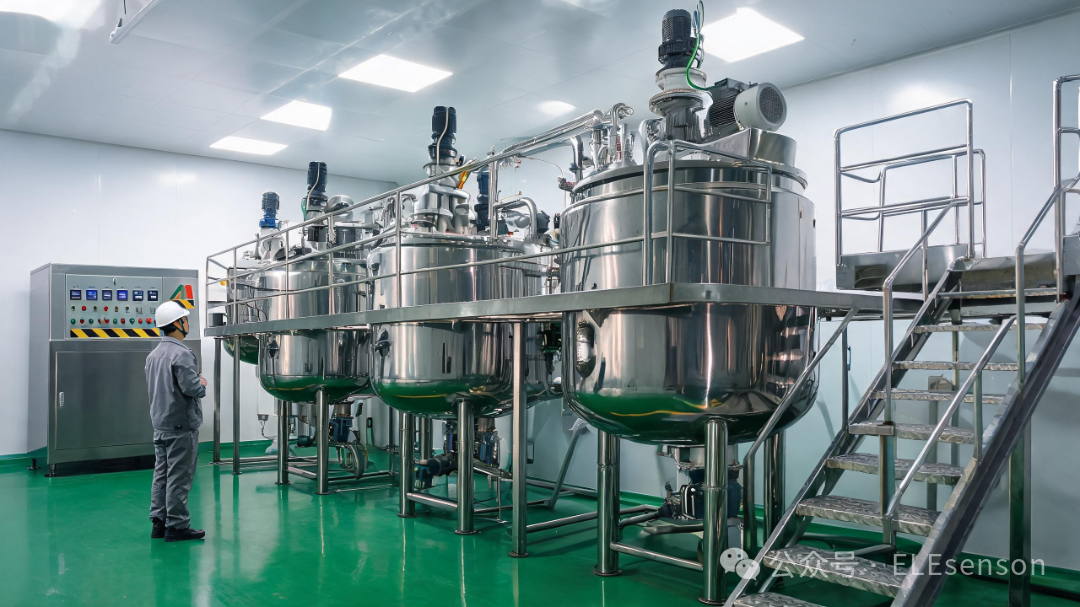
Realize high and low material level monitoring during jam stirring and boiling. The low-level protection function prevents equipment dry running and empty stirring; the high-level alarm avoids material overflow waste. Adapted to dynamic stirring and turbulent working conditions, it maintains stable level detection and ensures consistent cooking quality in each batch.
4.2 Finished Product Storage Tank
Monitor the real-time residual material level of finished jam storage tanks. Link with the conveying system to realize automatic material replenishment and automatic shutdown control. It effectively prevents production line shutdown caused by material shortage and material overflow accidents, realizing intelligent and unmanned management of finished product storage links.

4.3 Filling Station Hopper
Accurately monitor the material level of jam in the filling hopper, synchronize with the automatic filling beat, and solve production abnormalities such as insufficient material supply, filling interruption, and liquid spillage. It stabilizes the filling production process, reduces material waste and defective products, and effectively improves overall production yield and automation efficiency.

05.Product Conclusion
Penetrating foam interference and shielding material adhesion noise, ELEsenson sweep frequency level sensor accurately captures the real material level changes inside the tank. It converts invisible and complex production working conditions into precise and controllable data, stabilizes every link of jam boiling, storage and filling with professional food-grade detection technology, strictly controls production quality, and ensures every batch of fresh jam is delivered with stable quality and reliable safety.

Ultrasonic Double Sheet Sensor | Eliminate Sheet Stacking & Production Downtime
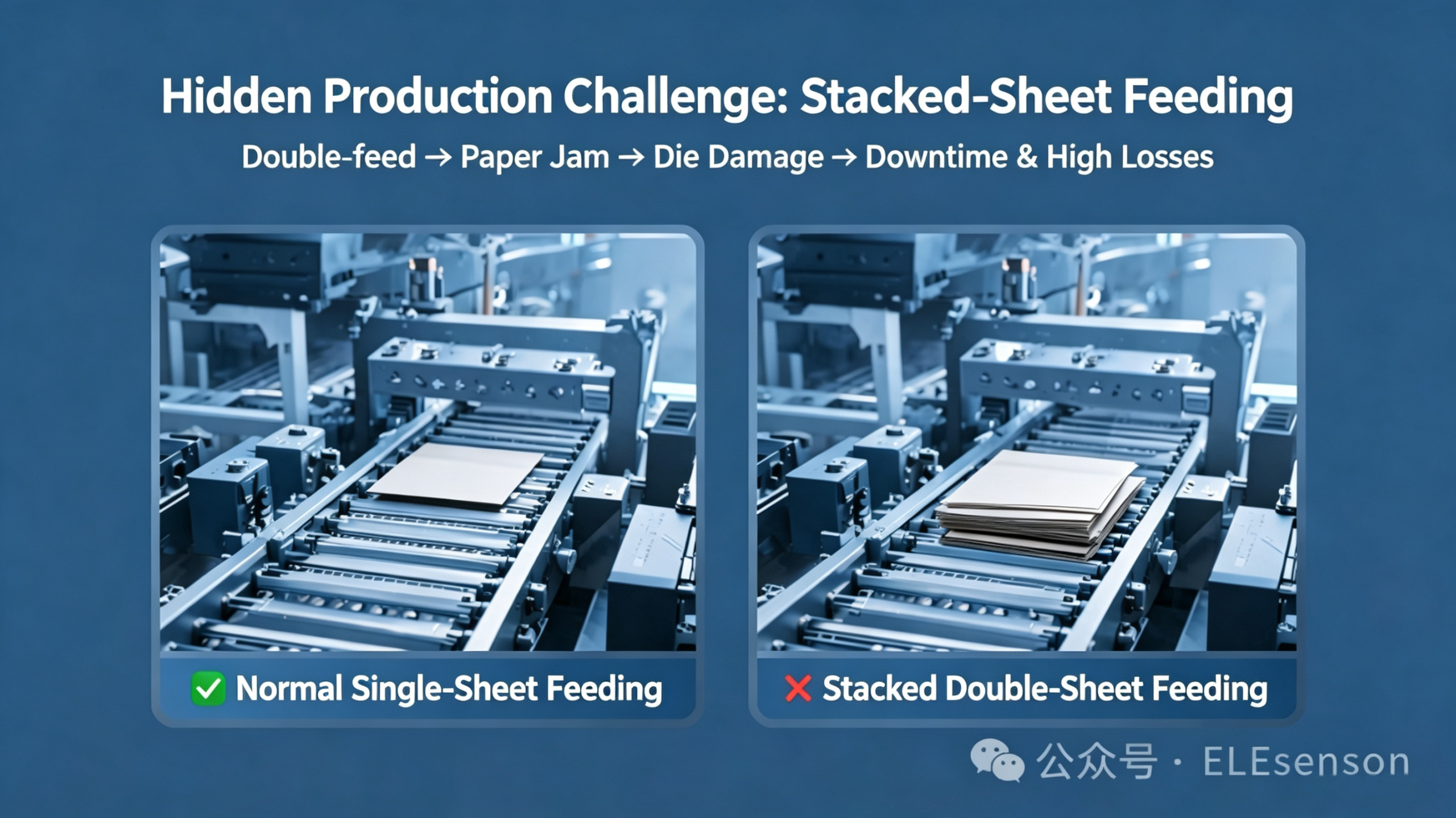
ELEsenson Ultrasonic Double Sheet Sensor is a professional non-contact detection device tailored for automated sheet feeding production lines. It fundamentally solves the common hidden failure of sheet overlapping, adhesion and double/multi-sheet feeding, effectively avoiding paper jams, product scrapping, tool and mold damage, and frequent equipment downtime caused by stacked materials. It delivers stable, high-precision layer detection for diverse thin materials across industrial scenarios, greatly reducing production loss and improving line operational efficiency.
01.Core Pain Points of Sheet Stacking in Automated Production
Sheet adhesion and overlapping feeding are long-standing invisible problems in automated processing. Due to static electricity, material friction and mechanical feeding deviation, two or more sheets often enter the workstation undetected. This abnormal condition directly triggers a series of production failures: equipment paper jams, finished product defects and scrapping, precision cutting tool wear, mold collision damage, and unplanned line shutdowns. These issues not only raise raw material and maintenance costs but also severely restrict continuous production capacity and product yield.
02.Working Principle: Non-Contact Ultrasonic Penetration Detection
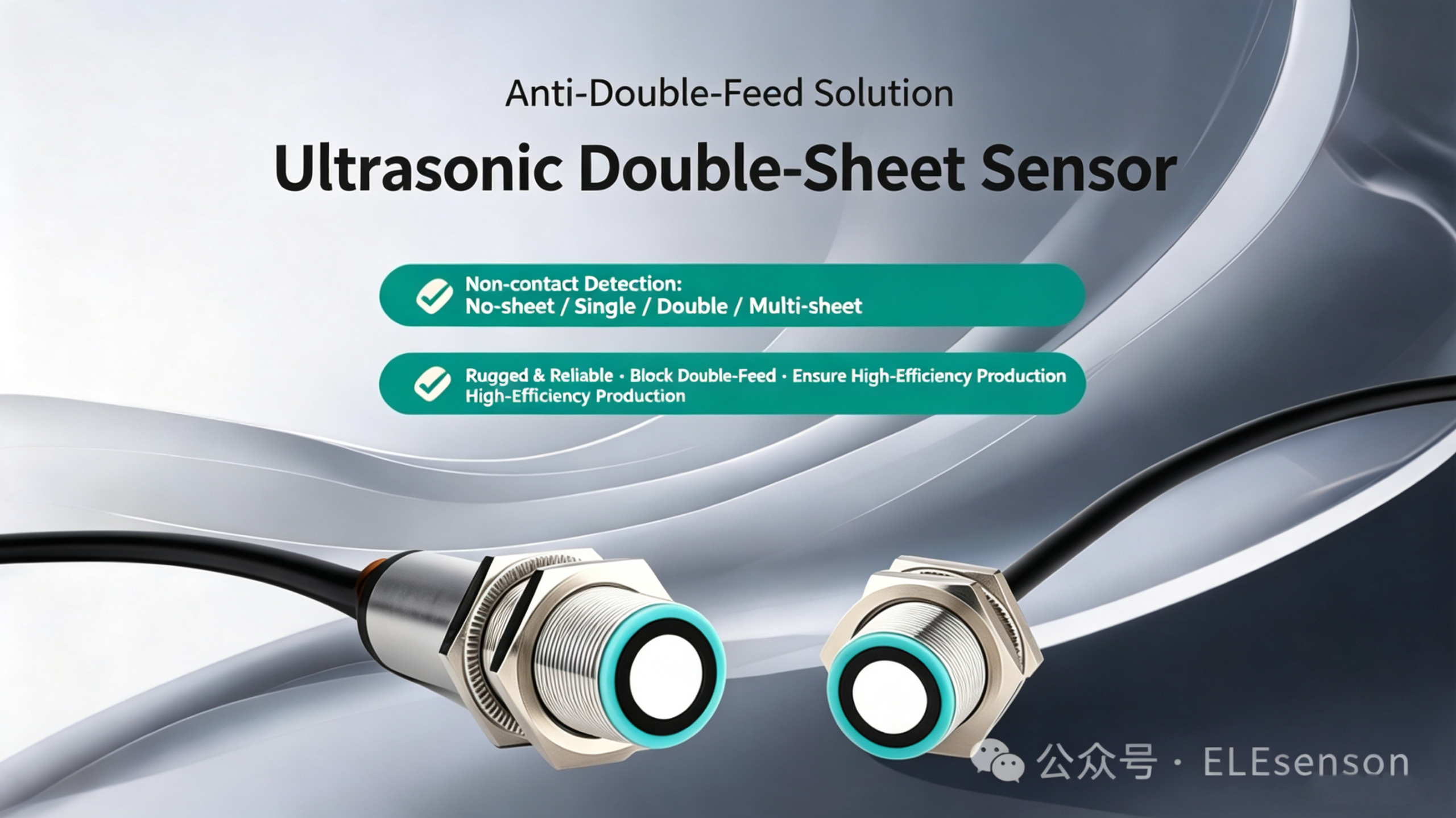
Different from traditional photoelectric sensors limited by material appearance, the ELEsenson ultrasonic double sheet sensor adoptsultrasonic sound wave penetration principle for non-contact real-time detection. It accurately identifies four material states: no material, single sheet, double sheets, and multi-sheet stacking. The sensor intercepts stacking risks at the feeding source, realizing full-process error prevention for sheet feeding and ensuring stable, continuous and efficient operation of automated production lines.
03.Core Advantages & Key Technical Features
3.1 Color & Transparency Independent Detection, Wide Material Compatibility
Relying on ultrasonic penetration rather than visible light reflection, the sensor is completely immune to material color, transparency, surface reflectivity and pattern differences. It perfectly makes up for the detection blind spot of photoelectric sensors on transparent and high-reflective materials. It supports reliable detection of paper, packaging film, aluminum foil, copper foil, lithium battery separators, and thin PCB boards, covering most thin industrial materials.
3.2 0.02–4mm Ultra-Wide Detection Range with One-Touch Teaching
It covers an ultra-wide material thickness range of0.02mm to 4mm, adapting from ultra-thin micro-films to thin metal sheets. Equipped with one-touch teaching function, it supports one-click parameter calibration during material switching. It greatly shortens production line changeover and debugging time, improves production flexibility, and meets the flexible production needs of multiple materials and multiple processes.
3.3 Millisecond High-Speed Response, Adapt to High-Speed Production Lines
With millisecond-level signal output speed, the sensor synchronizes with high-speed feeding equipment without delaying line operation. It maintains stable and accurate multi-layer identification and double-sheet judgment under high-frequency and high-speed operating conditions, ensuring detection accuracy and production efficiency do not conflict.
3.4 IP65 Industrial Protection, Stable for Harsh Workshop Environments
Built with IP65 dustproof and waterproof rating, the sensor integrates reverse connection protection and transient overvoltage protection functions. It resists workshop dust, light oil pollution, and temperature & humidity fluctuations. It effectively avoids false detection and missing detection during long-term continuous operation, maintaining consistent and reliable detection performance in complex and harsh industrial environments.
3.5 Plug-and-Play Integration, Compatible with PLC Systems
It supports optional NPN/PNP dual signal output, which can be directly connected to industrial PLC equipment. It features simple wiring, fast installation and zero-compatibility adaptation. It is applicable to both new automated machinery and old equipment renovation, realizing rapid deployment and online use with low application threshold.
04.Multi-Industry Industrial Application Scenarios
4.1 Printing & Packaging Industry
Applicable to printing machines, box gluing machines, laminating machines and collating machines. It detects paper, cardboard, label paper and packaging film, effectively preventing double-sheet feeding caused jams, printing registration errors and product scrapping. It reduces equipment maintenance frequency and stabilizes packaging line productivity.

4.2 Lithium Battery Manufacturing
Deployed on battery stacking workstations to detect battery separators, positive/negative electrode sheets, copper foil and aluminum foil. It accurately alarms for double-layer stacking, eliminates battery short-circuit risks caused by stacked electrode materials, improves battery product yield, and ensures safe and standardized battery production.

4.3 Precision Electronics Manufacturing
Suitable for conveying and detection of FPC flexible circuits, thin PCBs and silicon wafers. It identifies stacked sheet materials in real time to prevent multi-layer materials from entering precision processing stations, protecting cutting tools, stamping parts and precision electronic components from damage, and reducing precision equipment loss.

4.4 Flexible Packaging & Metal Stamping
Matching bag-making machines, film laminating production lines and hardware stamping sorting systems. It detects aluminum-plastic film, plastic film and thin metal sheets to avoid double-layer feeding faults, protect molds and core equipment, and reduce raw material waste and defective rate.
4.5 Food Packaging Production
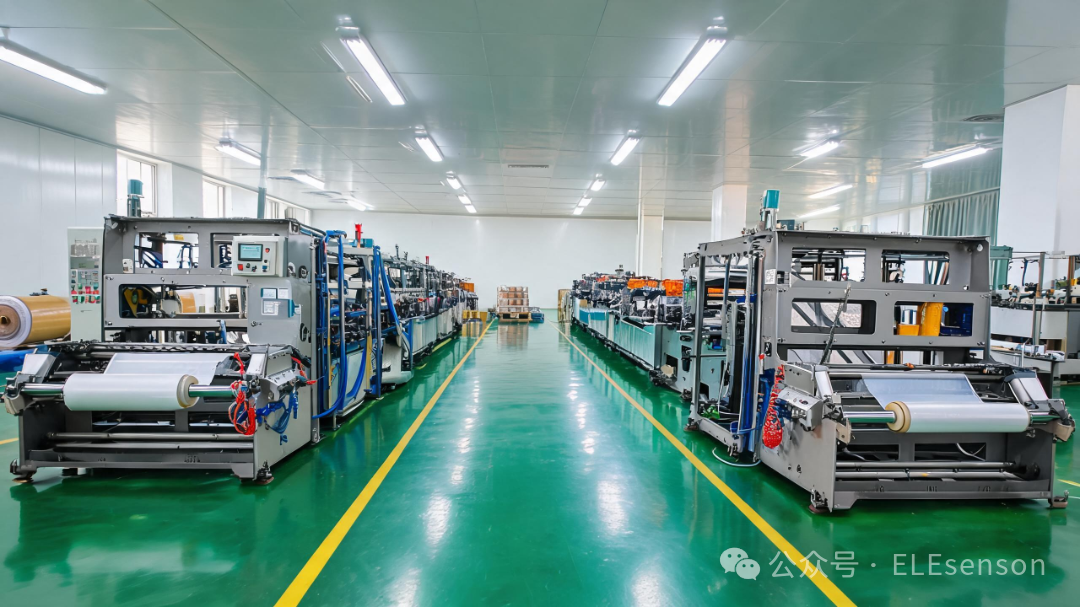
Food packaging films, aluminum-plastic composite films and seasoning bag materials are prone to adhesion due to static electricity. Installed on bag-making machines, seasoning bag distributors and snack sealing stations, the sensor intercepts double-layer film feeding, avoids poor sealing, product leakage and package damage, and eliminates line downtime caused by packaging jams.

05.Conclusion
Sheet stacking and adhesion are key invisible faults that restrict the stability and yield of automated production lines. The ELEsenson Ultrasonic Double Sheet Sensor solves industrial detection pain points with non-contact anti-interference performance, wide material adaptability, high-speed response and industrial-grade stability. It provides efficient and reliable error-proof detection solutions for printing, new energy, electronics, packaging and stamping industries.
ELEsenson focuses on industrial precision detection, with a full range of sensor products to solve various hidden production failures. We welcome users to share on-site production problems and customize targeted detection solutions.
Industrial Proximity Switch | High-Precision Non-Contact Position Detection Sensor
01.Common Pain Points of Traditional Mechanical Positioning Detection
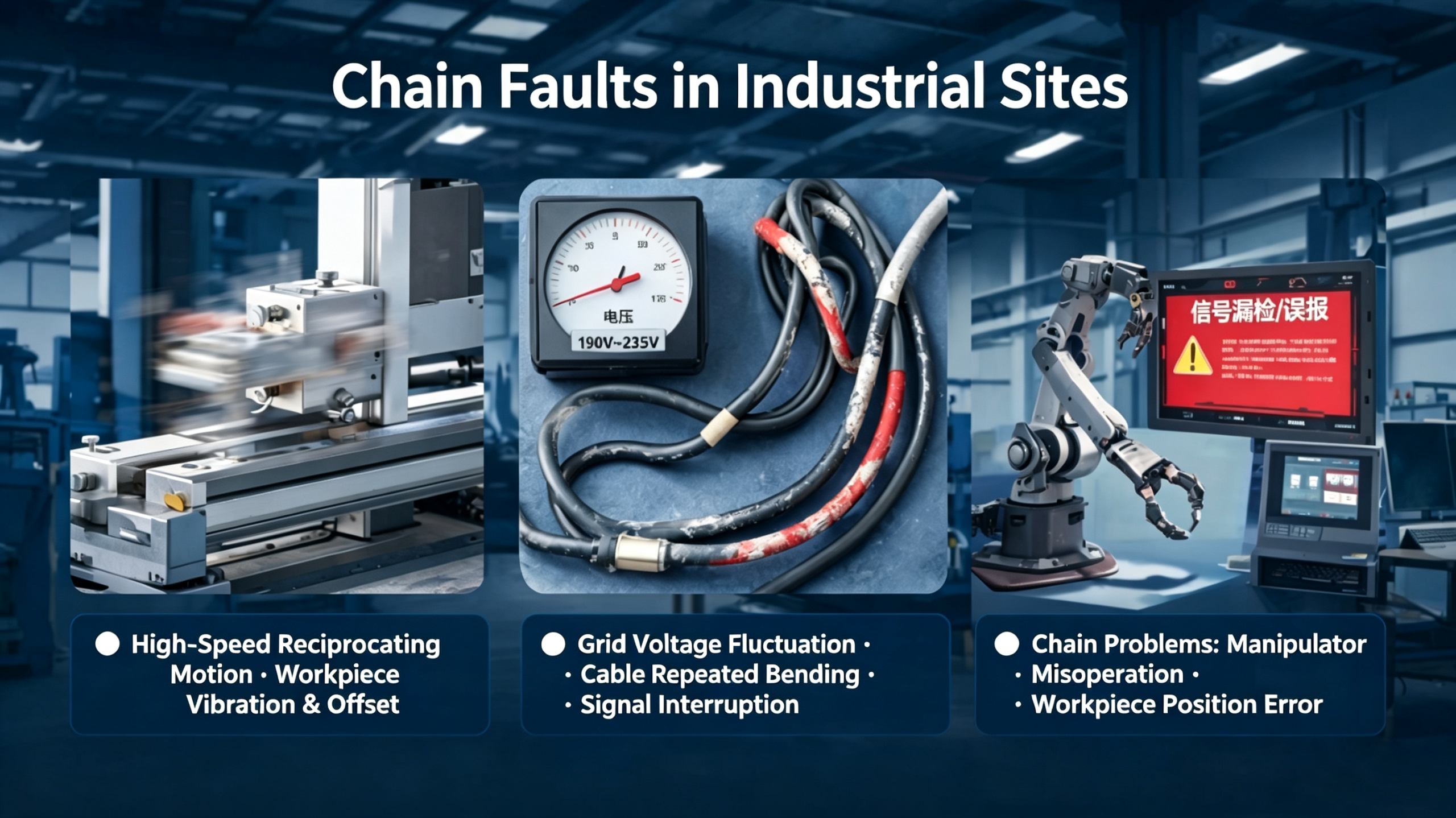
Many automated production lines still rely on traditional mechanical contact positioning methods, which cannot adapt to modern high-speed and high-frequency industrial production scenarios. On high-speed conveyor and assembly lines, frequent reciprocating equipment operation causes workpiece vibration, offset and positioning deviation. Meanwhile, workshop grid voltage fluctuation and long-term repeated cable bending easily lead to intermittent signal interruption, missed detection and false triggering.
These unstable detection problems directly cause industrial production anomalies such as empty grabbing by robotic arms, process misalignment and equipment jamming, seriously affecting production continuity, processing accuracy and operational stability, and bringing invisible losses to automated production.
02.Working Principle of Industrial Proximity Switch | Innovative Non-Contact Detection
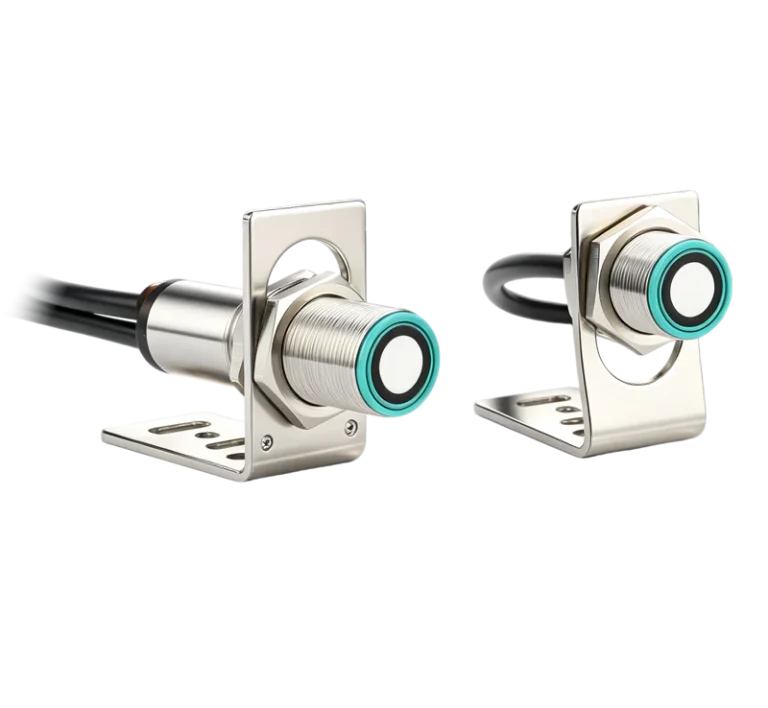
ELEsenson industrial proximity switches adopt advanced non-contact inductive sensing technology to realize contactless real-time position monitoring of metal workpieces and mechanical mechanisms. The sensor accurately captures in-place signals without physical contact, fundamentally eliminating mechanical friction and wear caused by contact detection. It effectively solves the instability pain points of traditional mechanical switches, ensuring long-term stable and high-efficiency operation of automated equipment.
03. Core Product Advantages & Key Performance Features
3.1 Non-Contact Sensing Design, Zero Mechanical Wear & Longer Service Life
Different from traditional contact limit switches, the proximity switch completes position induction through electromagnetic sensing without touching workpieces and equipment components. It completely avoids structural wear, deformation and failure caused by frequent contact collision. It greatly extends the service cycle of the sensor, reduces equipment replacement frequency and later maintenance costs, and is perfectly suitable for high-frequency reciprocating motion and long-cycle continuous operation scenarios.
3.2 Industrial-Grade Anti-Interference & High Environmental Adaptability
Built with professional anti-electromagnetic interference circuits, the switch effectively resists complex workshop interferences such as industrial dust, oil pollution, equipment vibration and electromagnetic field fluctuation. It supports reverse polarity protection and short-circuit protection, with an IP67 high-level waterproof and dustproof rating. It can operate stably for a long time in harsh working conditions including cutting fluid splashing, heavy dust and high-vibration environments, maintaining consistent and reliable signal output.
3.3 Millisecond Fast Response, Matching High-Speed Production Cycles
Featuring ultra-high switching frequency and millisecond-level signal response speed, the sensor realizes real-time synchronous detection and feedback. It perfectly matches the high-speed operation rhythm of cylinders, sliding tables, conveyor lines and automated mechanical arms, effectively avoiding signal lag, delayed detection and false triggering problems, and ensuring precise coordination of each production process link.
3.4 Diversified Specifications & Simple Installation, Strong Compatibility
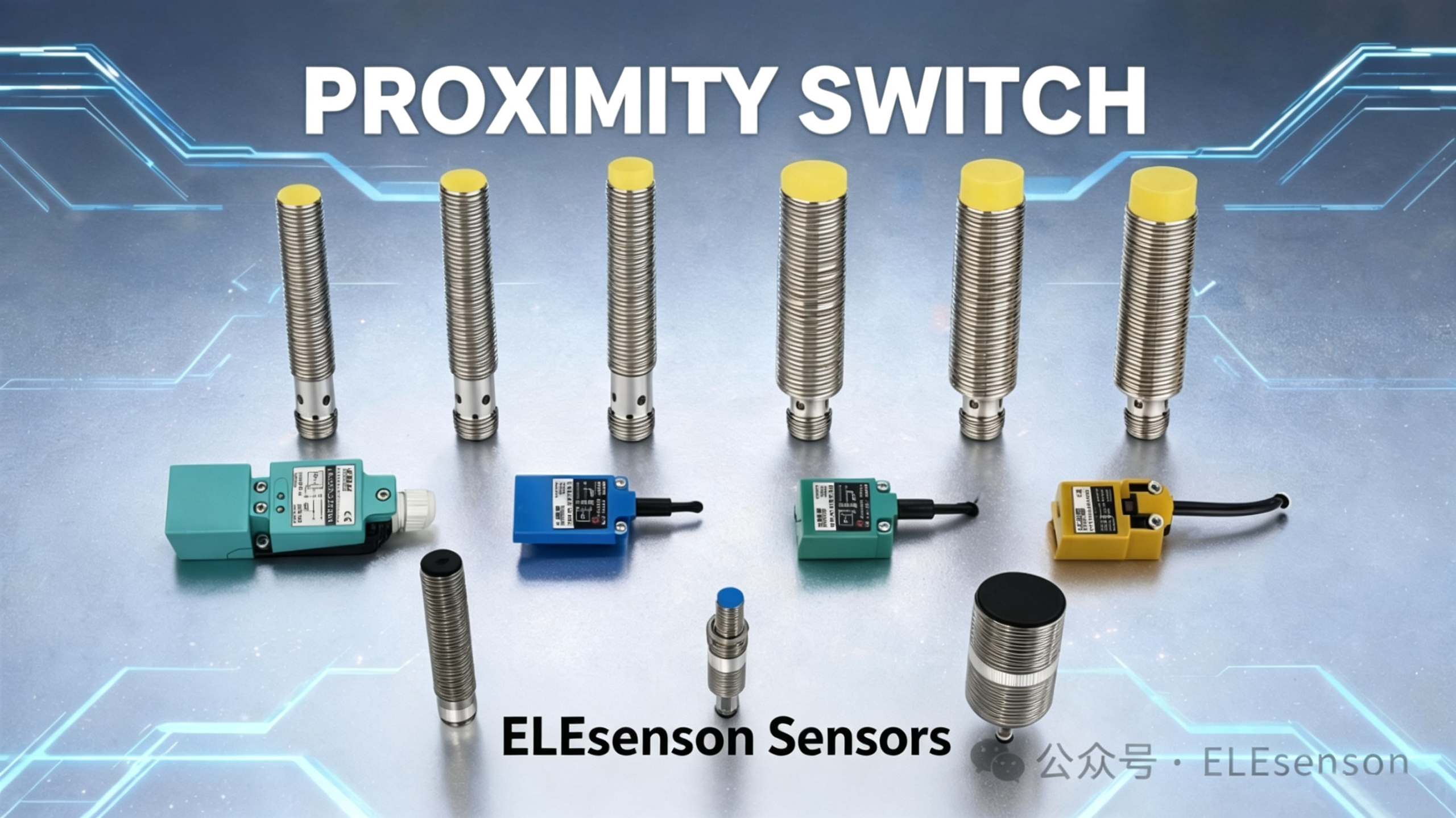
The product covers complete specifications including cylindrical M8, M12, M18, M30 and square models, supporting flush mounting and surface mounting in different installation spaces. It provides universal NPN/PNP signal output, which is highly compatible with mainstream industrial PLC control systems. It features simple wiring and convenient debugging, suitable for new equipment supporting installation and old production line renovation and upgrading.
3.5 Multiple Detection Ranges, Covering Full-Scenario Industrial Applications
Equipped with multiple optional sensing distances, it can flexibly meet diverse detection requirements from short-distance precise positioning to long-distance limit protection. It adapts to compact precision equipment and heavy-duty large-scale industrial machinery, realizing universal detection in various installation spaces and working scenarios.
04.Wide Application Scenarios, Safeguard Full-Line Automated Production
4.1 Machine Tool Processing Industry
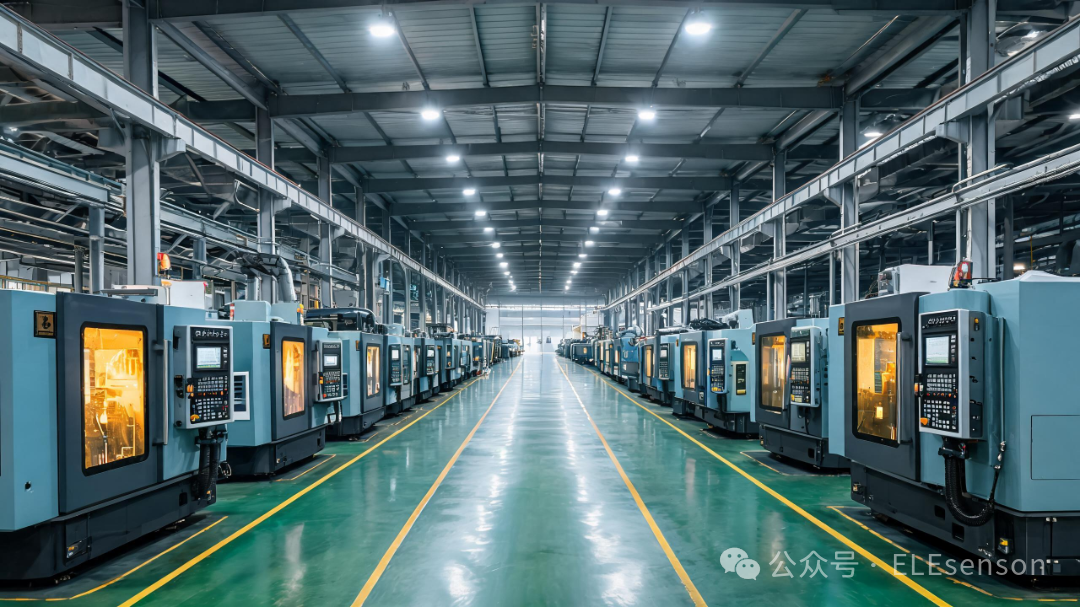
Widely used in CNC machine tools and machining centers for sliding table travel limit detection, tool change mechanism positioning and fixture in-place verification. It replaces traditional mechanical limit switches, effectively preventing equipment over-travel failures, protecting machine tools and workpieces from damage, and ensuring high-precision machining standards.
4.2 Automated Assembly Lines
Applied to automated assembly and conveyor systems to realize metal workpiece presence detection, station positioning verification and product counting statistics. It transmits accurate position signals to the control system, standardizes the orderly operation of production processes, and guarantees continuous and efficient operation of assembly lines.

4.3 Packaging Machinery Equipment
Matching bag making machines, filling machines, sealing machines and other packaging equipment, it is used for mechanical baffle and cylinder position detection, and mechanism reset verification. It precisely coordinates the operation sequence and beat of each process, effectively reducing equipment jamming, misoperation and frequent failures.

4.4 Logistics Warehousing & Sorting Equipment
Suitable for lifting platforms, transplanting machines and intelligent sorting equipment, realizing lifting travel limit detection and pallet in-place monitoring. It avoids equipment overshoot risks, eliminates potential safety hazards, and ensures safe and stable operation of intelligent warehousing and logistics equipment.

4.5 Automotive Parts Manufacturing
Used for positioning monitoring of welding fixtures, assembly jigs and detection fixtures. It accurately identifies workpiece clamping and positioning status, effectively reducing assembly errors and defective products, and improving the overall safety and yield of automotive production lines.

4.6 Food Processing Equipment
Adapted to food processing and packaging clean production scenarios, it completes mechanical component position detection through non-contact induction. It avoids dirt accumulation and sanitary dead corners caused by contact detection, meets food-grade clean production standards, and ensures stable and hygienic equipment operation.

4.7 Heavy Industry & Construction Machinery
Applied to engineering lifting equipment and heavy-duty construction machinery for travel limit and stop position monitoring. It effectively prevents mechanical over-travel operation, eliminates equipment collision and structural damage risks, and reduces on-site construction safety hazards.

05.Product Value Summary
Different industrial scenarios pose completely different operational challenges: lifting equipment requires vibration resistance, machine tools need cutting fluid corrosion resistance, and food production demands clean and pollution-free detection. ELEsenson industrial proximity switches integrate anti-vibration, anti-corrosion, dustproof, waterproof and high-precision performance, targeting the differentiated needs of various industries. With reliable non-contact detection technology, it solves various positioning pain points in automated production, providing stable, efficient and cost-effective sensing support for modern industrial intelligent manufacturing.
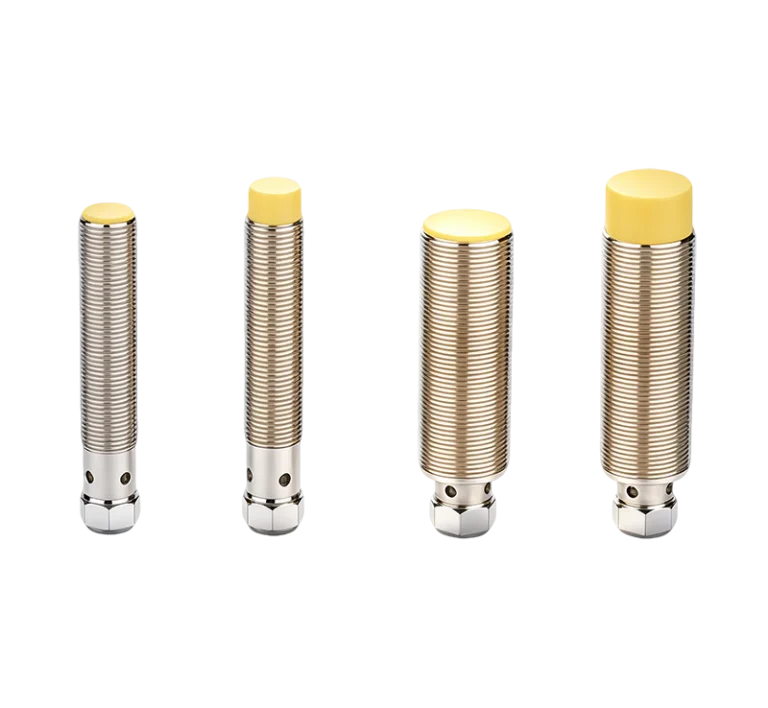
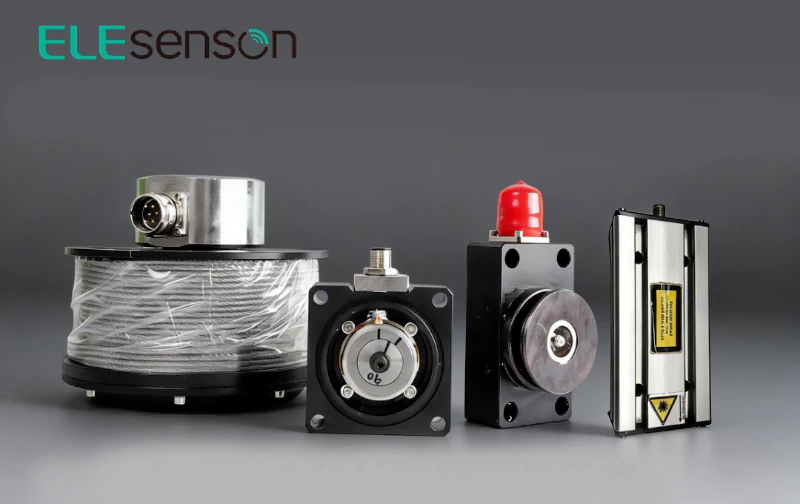
Rock Drill Sensor Kit | Angle, Depth & Laser Positioning for Intelligent Drilling
Intelligent Tunneling
The Sensing Revolution
ELE launches a professional all-in-one rock drill sensor kit, integrating angle monitoring, precise depth measurement, boom extension detection, and laser positioning. Designed for mine tunneling, tunnel excavation, foundation pit anchoring, and underground engineering, this full-set sensing solution upgrades traditional manual-dependent rock drills into digital precision drilling equipment, ensuring every borehole is constructed strictly according to design standards.
In underground drilling projects, borehole positioning accuracy, depth control precision, and real-time construction monitoring directly determine engineering safety, material consumption, and overall project cost. Traditional drilling operations rely entirely on worker experience and simple manual measurement, which inevitably leads to three major industry pain points: severe hole position deviation that ruins blasting and anchoring accuracy; inaccurate depth control causing over-excavation or under-excavation and massive material waste; and blind drilling processes with no real-time data feedback for status tracking and quality verification.
To solve the long-standing precision and digitalization bottlenecks of rock drilling construction, ELE independently developed four core smart sensors for rock drills: angle sensor, depth sensor, extension sensor, and laser positioning sensor. The four-in-one data fusion system realizes full-process, full-dimensional intelligent perception of drilling posture, penetration depth, boom extension status, and hole positioning, enabling standardized, visualized, and traceable intelligent tunneling operations.
1.Four Core Sensors | Full-Dimensional Drilling Perception System
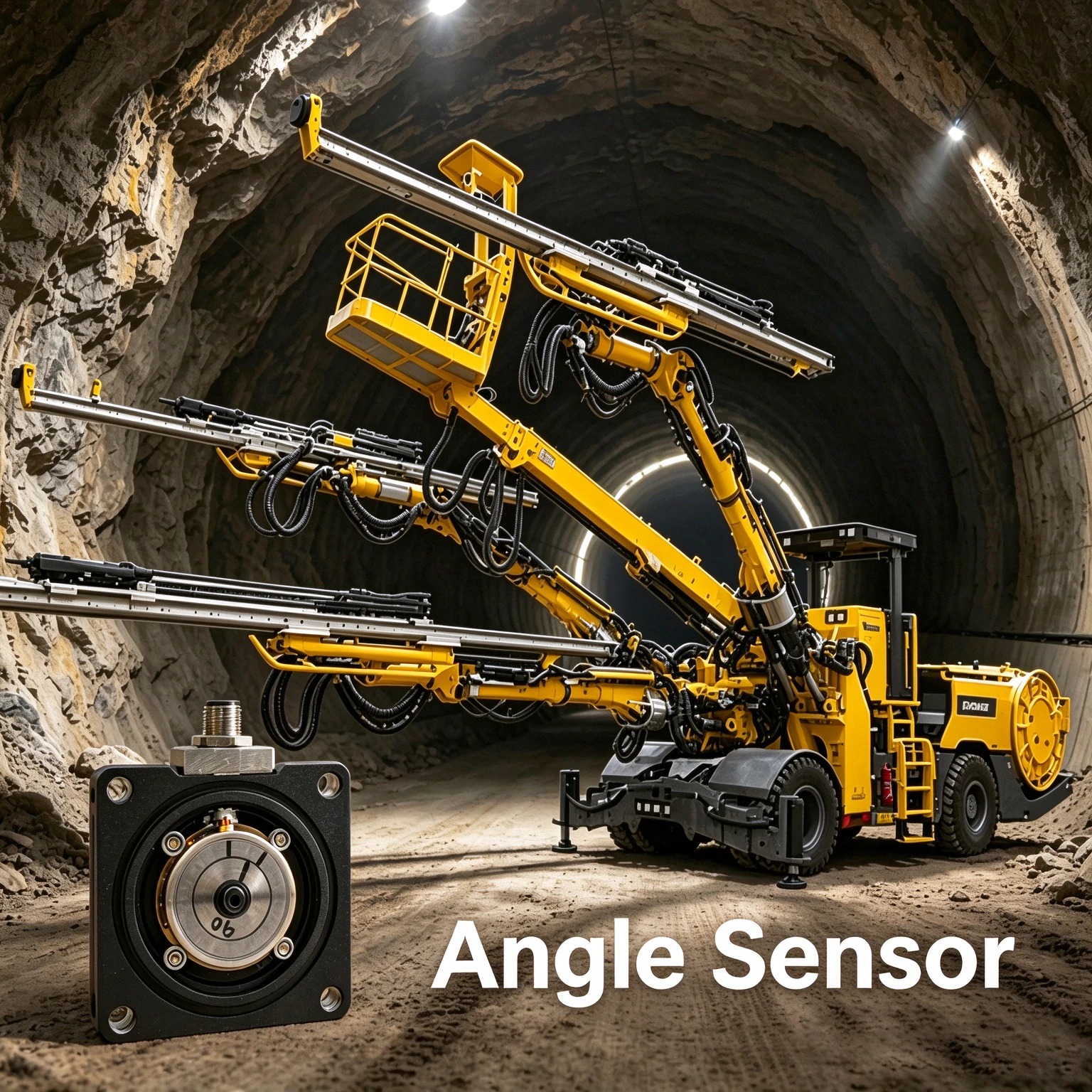
1.1 Rock Drill Angle Sensor
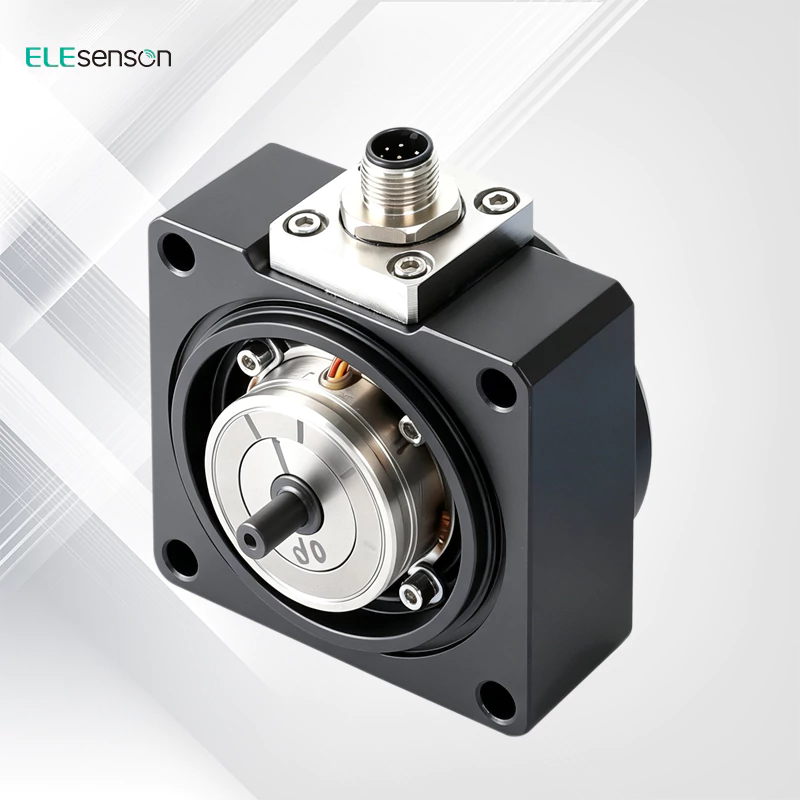
Built with high-precision MEMS three-axis accelerometer and gyroscope, paired with optimized Kalman filtering algorithm, ELE angle sensor accurately outputs real-time Euler angle data including roll, pitch, and yaw of drill booms and propulsion beams relative to the absolute horizontal plane and heading direction. It supports multiple industrial universal protocols including CANopen, RS485 Modbus RTU, and 4–20mA analog output, perfectly adapting to mainstream drilling rig control systems.
The sensor achieves 24-hour real-time dynamic monitoring of drilling horizontal angle, pitch angle, and roll angle, effectively correcting drilling posture deviation during operation. It ensures the actual drilling angle is completely consistent with the design value, thoroughly eliminating hole deflection problems caused by manual visual judgment errors.
1.2 High-Precision Depth Sensor
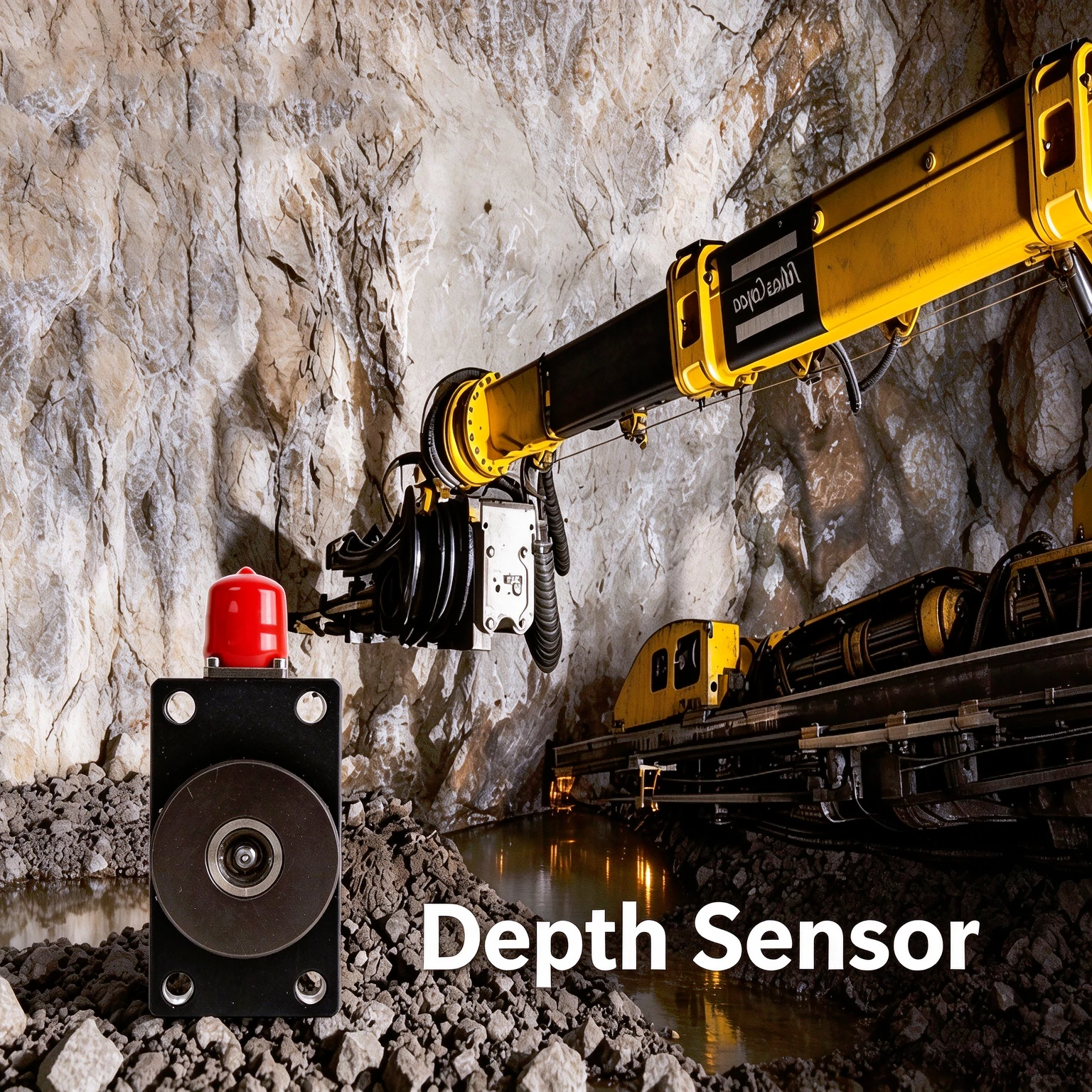
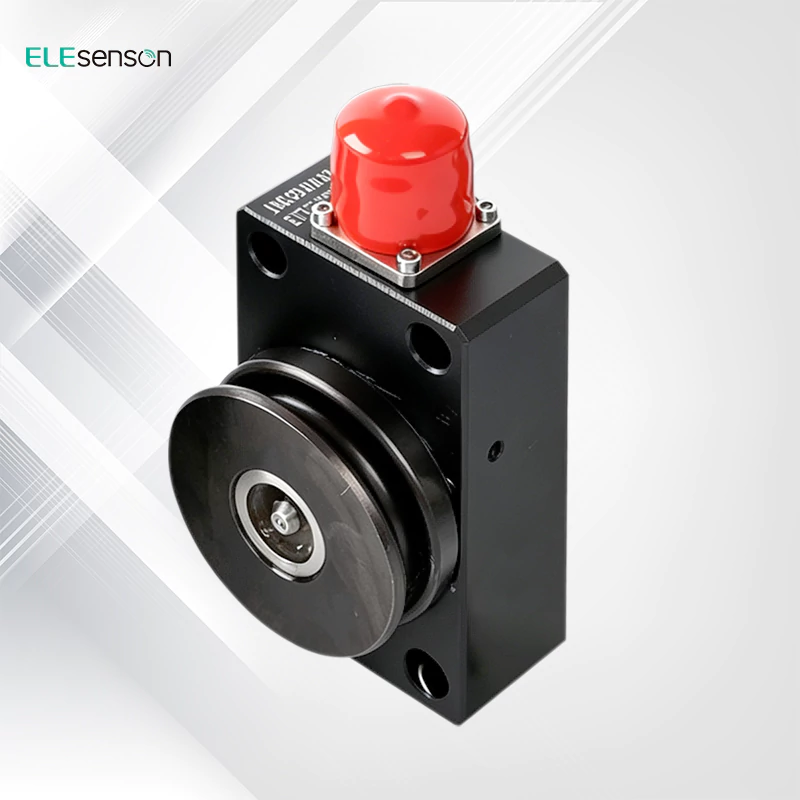
ELE rock drill depth sensor adopts dual technical solutions of magnetostrictive non-contact displacement measurement and high-resolution incremental encoder contact measurement, matched with mechanical limit protection switches. Installed on drive cylinders and chain drive sprockets, it features built-in temperature compensation and signal conditioning modules to adapt to severe underground temperature changes.
Supporting dual redundant signal output and wire break detection for safety-level reliability certification, the sensor achieves a measurement resolution up to 0.5mm and linearity ≤ ±0.05% FS. The standard measurement range covers 0–6m, with customizable extended range up to 10m. It accurately records real-time drilling penetration depth, avoiding over-excavation and under-excavation, and standardizing drilling depth quality control.
1.3 Boom Extension & Tension Sensor
For telescopic and folding drill boom rock drills, the actual feed extension length is inconsistent with the single cylinder stroke due to mechanical gaps and structural elastic deformation. Relying solely on cylinder stroke conversion will cause cumulative errors of 1–3cm, seriously affecting long-hole drilling accuracy.
ELE extension sensor adopts draw-wire encoder and laser distance measurement module to directly detect the real extension distance of the front drill rod guide frame relative to the rear fixed pivot. It synchronizes and fuses data with the depth sensor, and automatically switches depth calculation models according to drill boom splicing and extension states. For deep hole drilling over 10m, it controls comprehensive positioning deviation within 2cm, greatly improving the precision of large-span tunnel pipe arch support and horizontal core drilling.
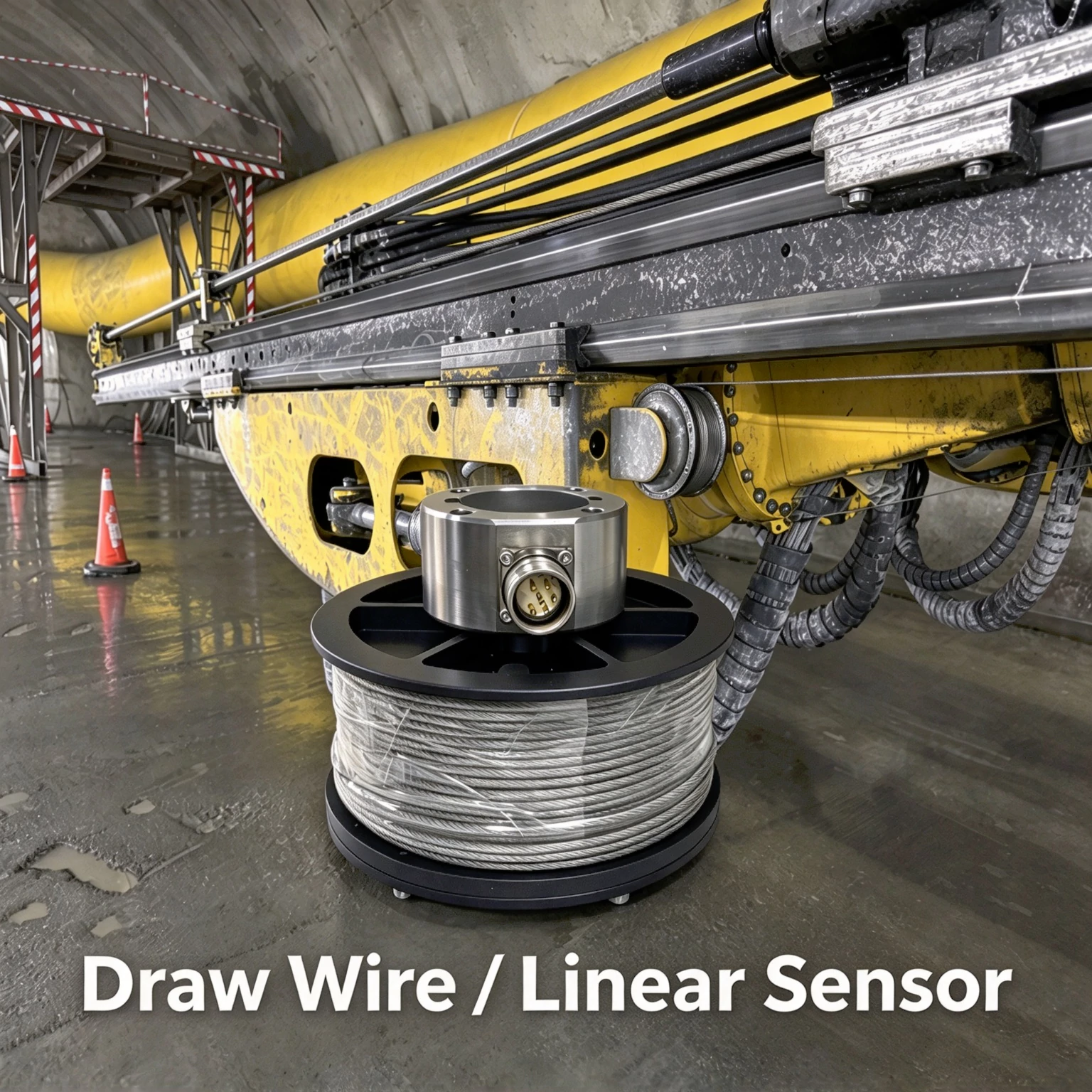
1.4 High-Visibility Laser Positioning Sensor
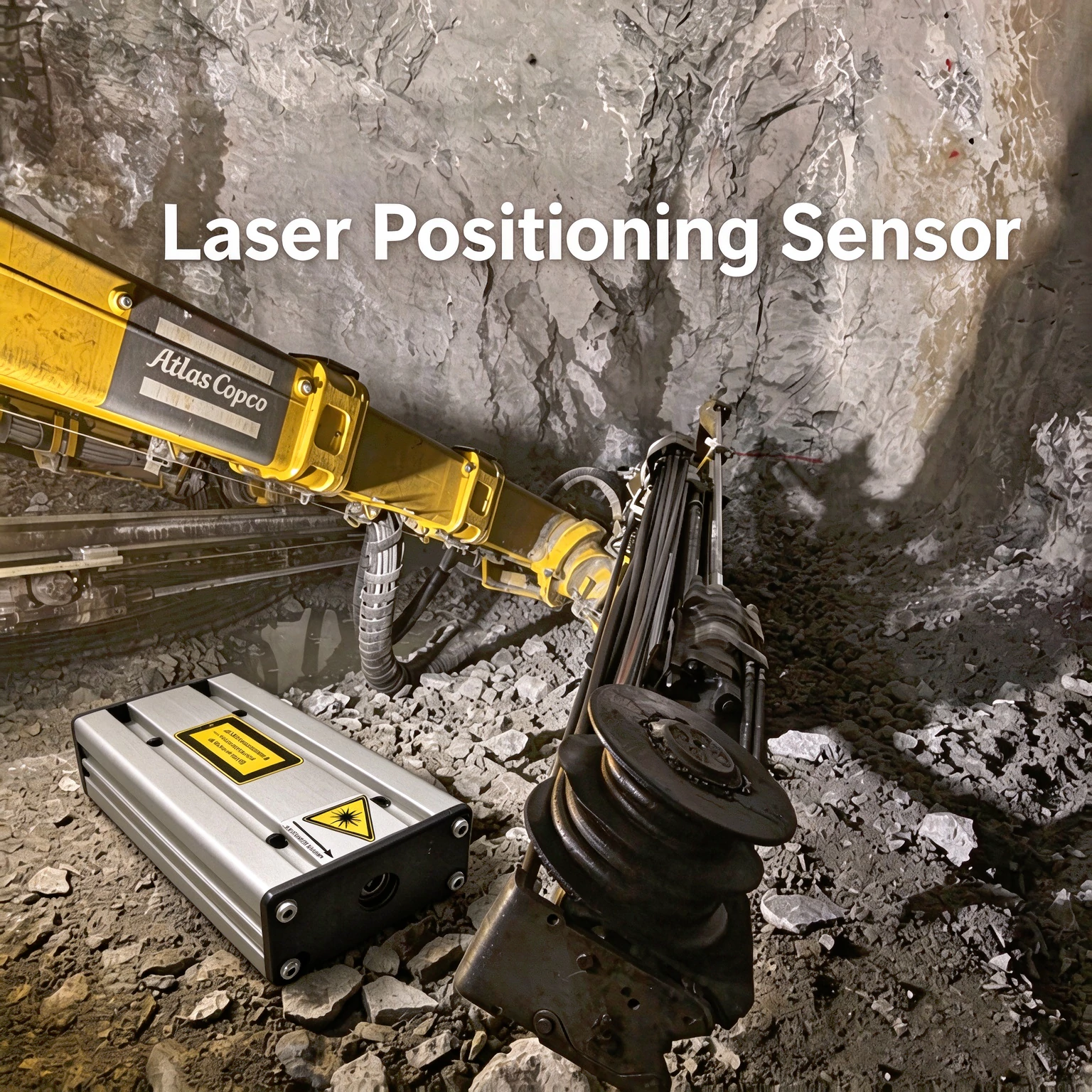
Different from ordinary single-point laser pointers, ELE laser positioning sensor integrates cross/dot laser emission module and coaxial image acquisition sensor. During construction, the laser is projected onto the tunnel working face; the system intelligently identifies laser alignment offset through image processing algorithm and outputs millimeter-level deviation data via CAN bus, guiding operators to complete precise fine-tuning of drill booms.
Tunnel environments feature weak light, heavy water mist, and high dust, which cause ordinary laser positioning to fail. ELE adopts 520nm green laser with ≤5mW safe power, maintaining clear imaging and recognizable alignment effects under 2000lux strong ambient light. The pulsed laser enhancement mode further improves anti-interference ability in dusty and humid working conditions, ensuring stable and accurate positioning in complex tunnel environments.
 2.Core Value | Data Fusion Creates Intelligent Drilling Upgrade
A single sensor can only realize partial data monitoring, while the core advantage of ELE four-piece rock drill sensor kit lies in multi-sensor data fusion and integrated collaborative control. It breaks the isolated data problem of single-point monitoring, builds a closed-loop intelligent perception system of “angle posture + penetration depth + boom extension + laser positioning”, and completely changes the traditional empirical and blind drilling mode.
By upgrading ordinary hydraulic rock drills with this full-sensing kit, traditional construction machinery is transformed from pure “power tools” into high-precision “intelligent drilling robots”. It realizes full-process digital monitoring, visual construction, and quantifiable quality inspection for tunneling and anchoring projects, effectively reducing construction errors, lowering rework rates, and improving overall engineering efficiency and safety standards.
3.Typical Application Scenarios
- Mine Tunnel Drilling: Precise positioning of blasting holes and anchor holes to ensure uniform hole arrangement and consistent blasting effect.
- Traffic Tunnel Excavation: Full-process deviation correction for deep hole drilling to improve tunnel forming accuracy.
- Foundation Pit & Slope Anchoring: Standardized depth and angle control for anchoring holes to enhance overall structural stability.
- Underground Core Drilling: High-precision positioning for long-distance horizontal drilling to meet geological exploration precision requirements.
Angle Sensor
Click to view
Depth Sensor
Click to view
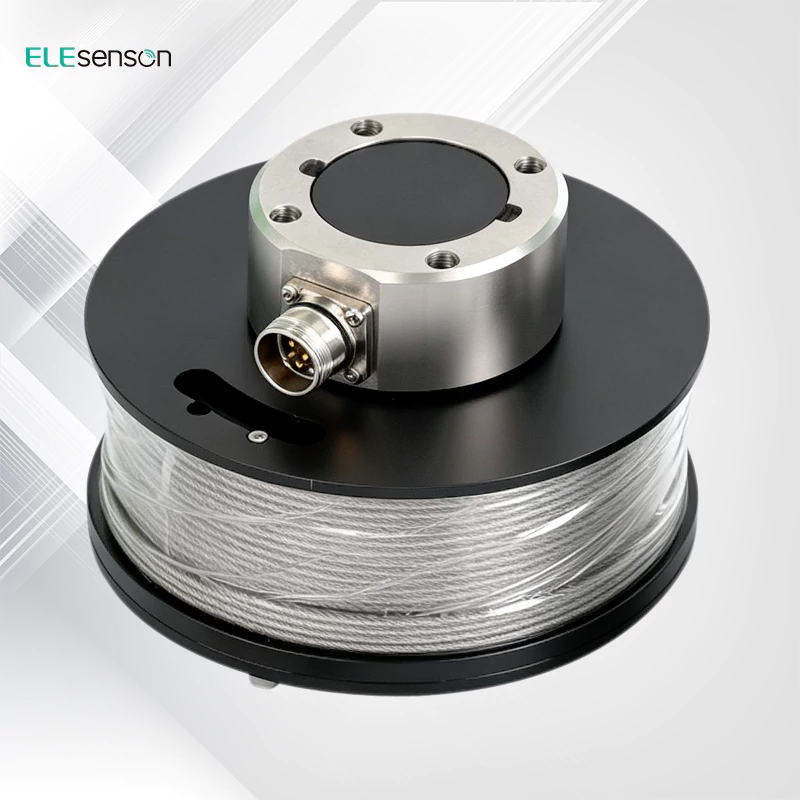
Linear Sensor
Click to view
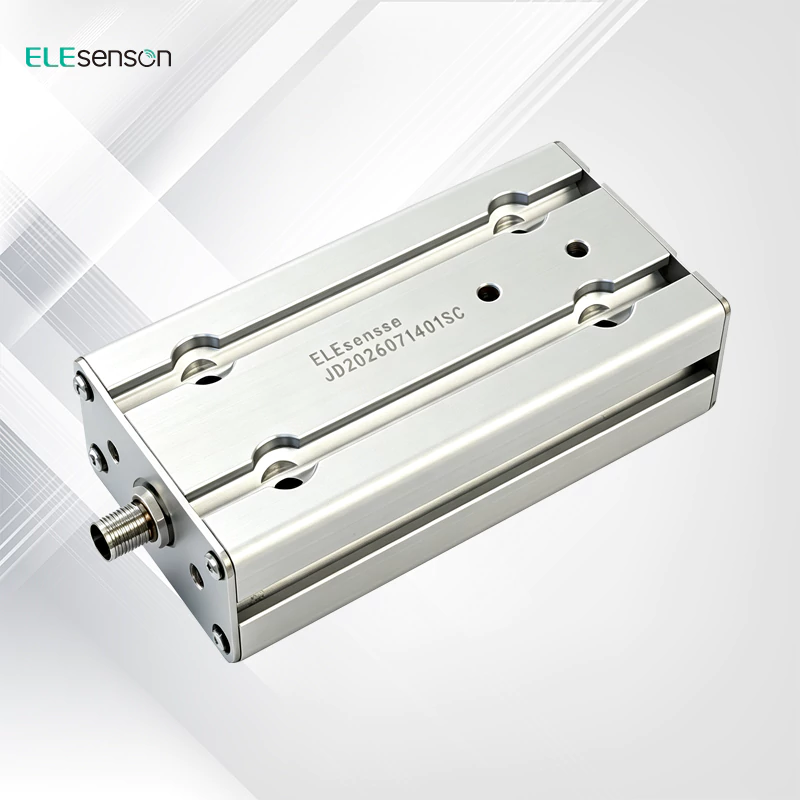
Laser Positioning Sensor
Click to view
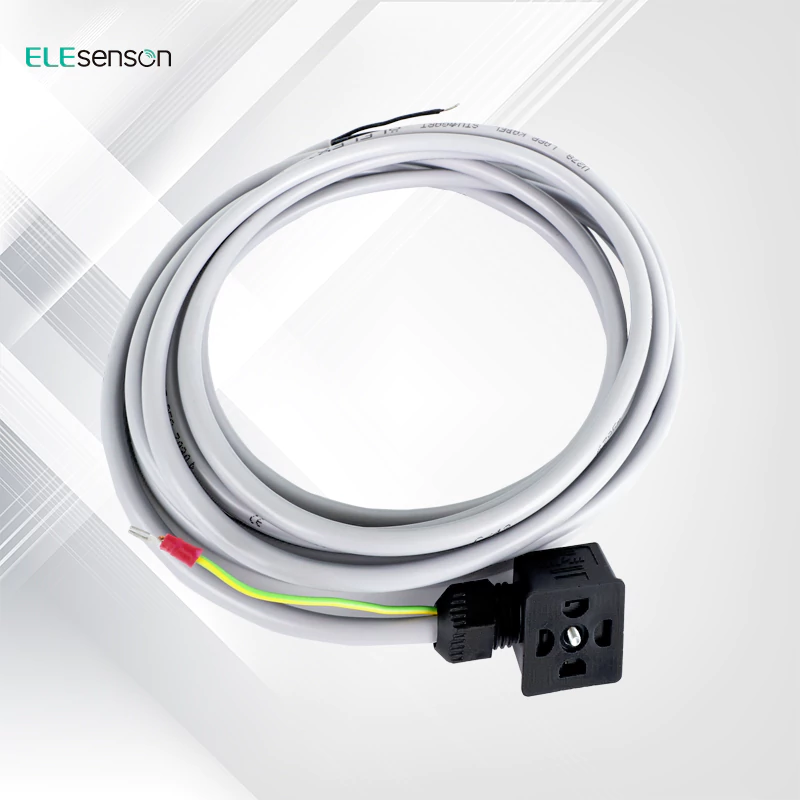
Rock Drill Cables
Click to view
Vision Length Measurement System | Non-Contact Online Metering & AI Defect Inspection
CCD Machine Vision + Precision Metering + AI Defect Detection. ELE all-in-one vision length measurement system solves three core production pain points for roll material manufacturing lines: inaccurate length counting, manual missing defects, and insufficient quality traceability. Widely applicable to textiles, chemical fibers, cables, plastic films, metal strips, and paper industries, this intelligent visual inspection equipment replaces traditional contact encoders and manual visual inspection, helping enterprises achieve precision production, standardized quality control, and full-process data traceability.
Traditional contact wheel counting and manual inspection can no longer meet modern factories’ requirements for high precision, high speed, zero-defect production, and intelligent management. As a professional industrial vision inspection manufacturer, ELE independently develops vision-based length measurement systems to realize non-contact metering, full online defect detection, and cloud data traceability, effectively reducing production costs, improving overall efficiency, and eliminating quality dispute risks.
01.Eliminate Traditional Defects, Redefine Industrial High-Precision Metering
Hidden Drawbacks of Traditional Contact Counting Equipment
Most conventional length counters rely on encoder and contact wheel friction measurement. After long-term continuous operation, mechanical slippage, roller wear, and structural loosening inevitably occur, resulting in accumulating measurement errors over time. This long-standing problem leads to inconsistent finished material length, raw material waste, inaccurate delivery metering, and even customer reconciliation disputes, return claims, and corporate reputation losses.
Core Advantages of ELE Non-Contact Vision Metering System
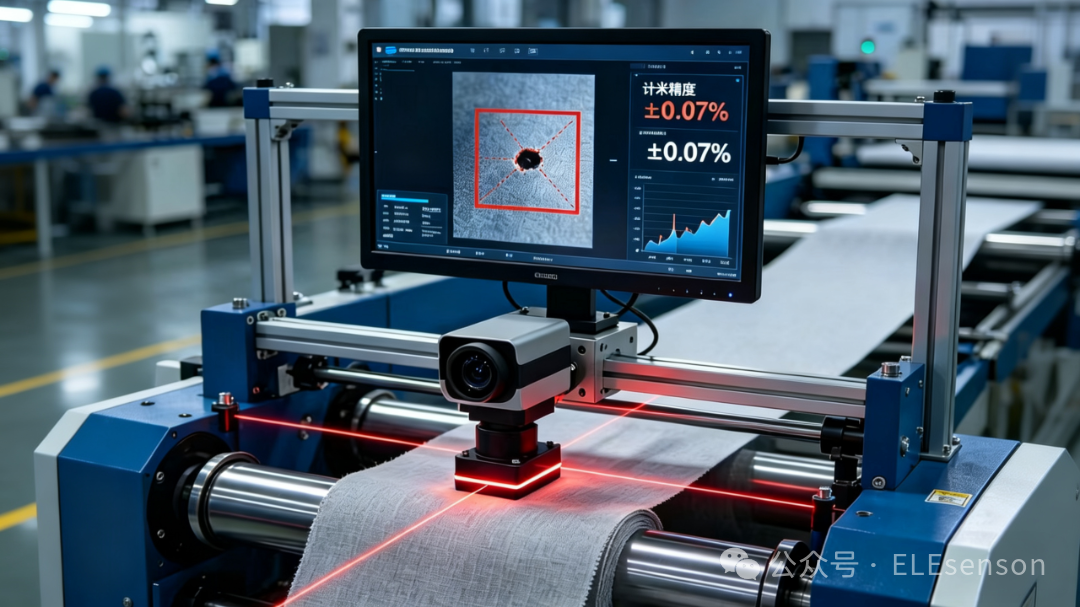
Breaking the limitations of mechanical contact measurement, the ELE intelligent vision length measurement system adopts CCD linear scan industrial camera + high-precision image analysis algorithm. It captures real-time surface texture features and tracking points of rolling materials without any surface contact, realizing dynamic high-precision length calculation.
With zero friction and zero wear throughout the whole process, there is no slippage error or mechanical aging drift. The measurement accuracy is stably controlled within ±0.1% permanently, completely solving the accuracy attenuation problem of traditional devices. Every roll of material achieves true, reliable, and traceable length data.
02.All-in-One Design | One Device Covers Three Core Production Functions
Abandoning the traditional single-function single-device redundant configuration, the ELE vision system integrates precision length metering, AI full-scale defect detection, and cloud quality traceability in one unit, comprehensively upgrading and replacing backward production and inspection modes.
Comparison Item | Traditional Production Mode | ELE Visual Intelligent Solution |
Length in meters | Encoder contact counting, prone to slippage and wear; errors gradually accumulate with usage time. | Pure optical non-contact measurement; lifelong zero wear; accuracy always stable at ±0.1%. |
Defect Detection | Manual visual inspection with low efficiency and severe visual fatigue; extremely high missing and misjudgment rates. | 100% full online CCD scanning + AI intelligent classification identification; accurate capture of tiny defects. |
Quality Traceability | No effective data retention; difficult quality problem verification; frequent after-sales disputes. | Independent inspection report for each roll; cloud data storage; full-process quality traceability. |
03.Core Industry Applications | First Choice for Textile Intelligent Upgrade
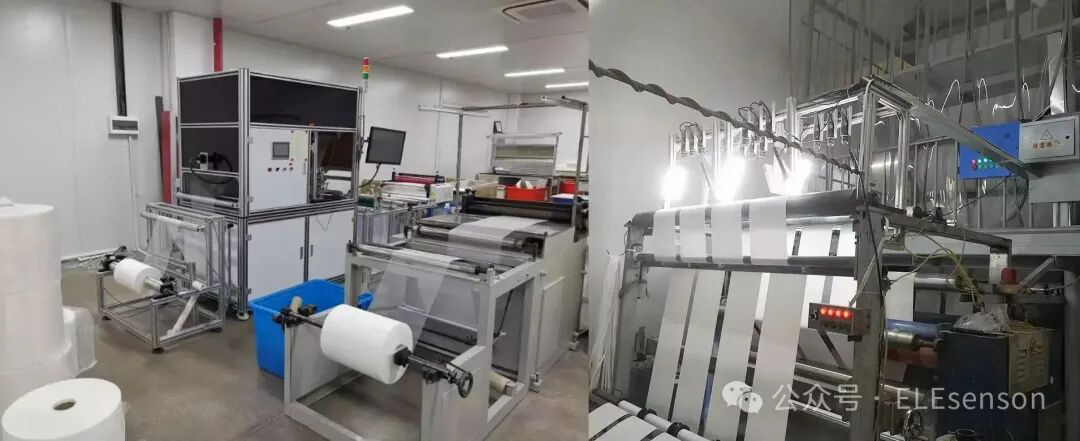
Rolled textile materials represent the largest automated inspection demand scenario with the highest transformation return on investment. At present, China has more than 4,000 textile and nonwoven production lines, with an annual output of 8 million tons. However, the automated inspection penetration rate is only 15%–20%, and over 90% of production lines still rely on manual sampling inspection, resulting in high labor costs, unstable quality, and high defect rates.
3.1 Nonwoven Fabric Production Line
Installed at the winding station front end, the system realizes one-stop intelligent control for the entire production process:
- High-precision Metering: Millimeter-level visual counting eliminates slippage errors and material loss, supporting accurate output statistics and material consumption analysis.
- Full Defect Inspection: Automatically identifies holes, oil stains, crystal spots, lumps, wrinkles, uneven thickness and other common defects, with AI automatic classification and data statistics.
- Intelligent Alarm & Marking: Triggers sound-light alarm and automatic inkjet marking immediately after defect identification, facilitating precise cutting and rework in subsequent processes.
- Full Data Traceability: Generates exclusive quality inspection reports for each roll of material to realize visualized production management.
Core Value: Realizes 100% full coverage inspection instead of traditional 5% manual sampling rate, reduces missing inspection rate to nearly zero, and cuts customer quality complaints and return disputes by 80%.
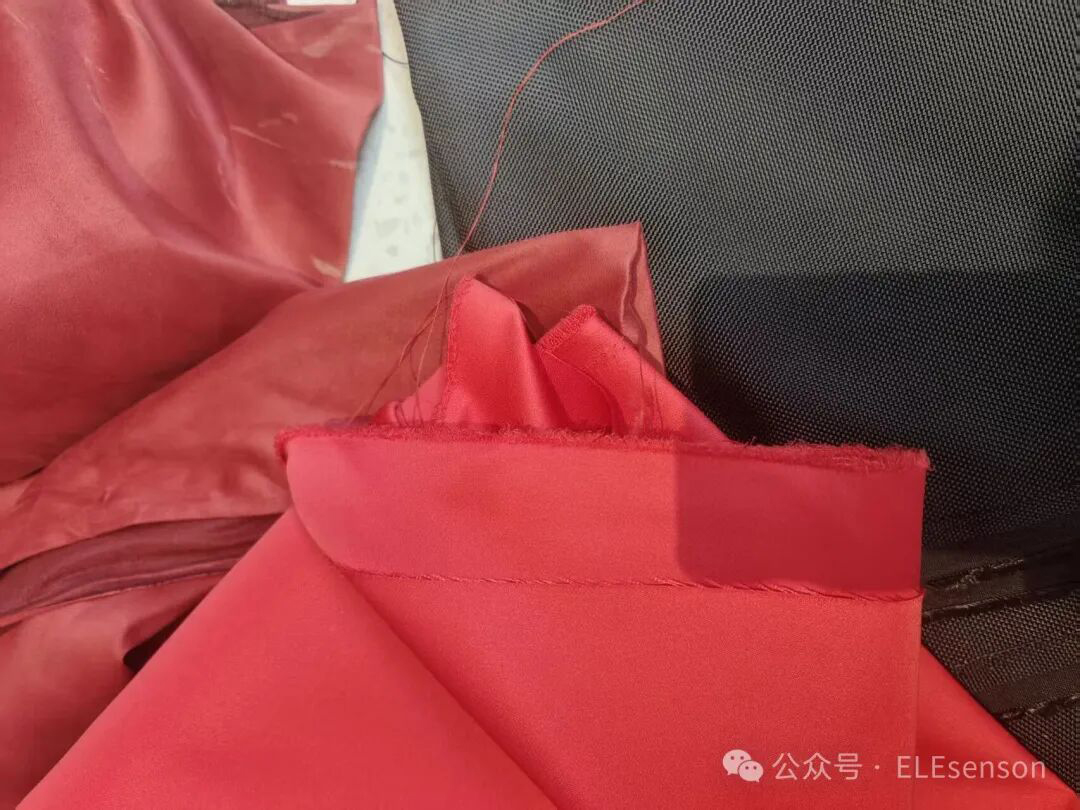
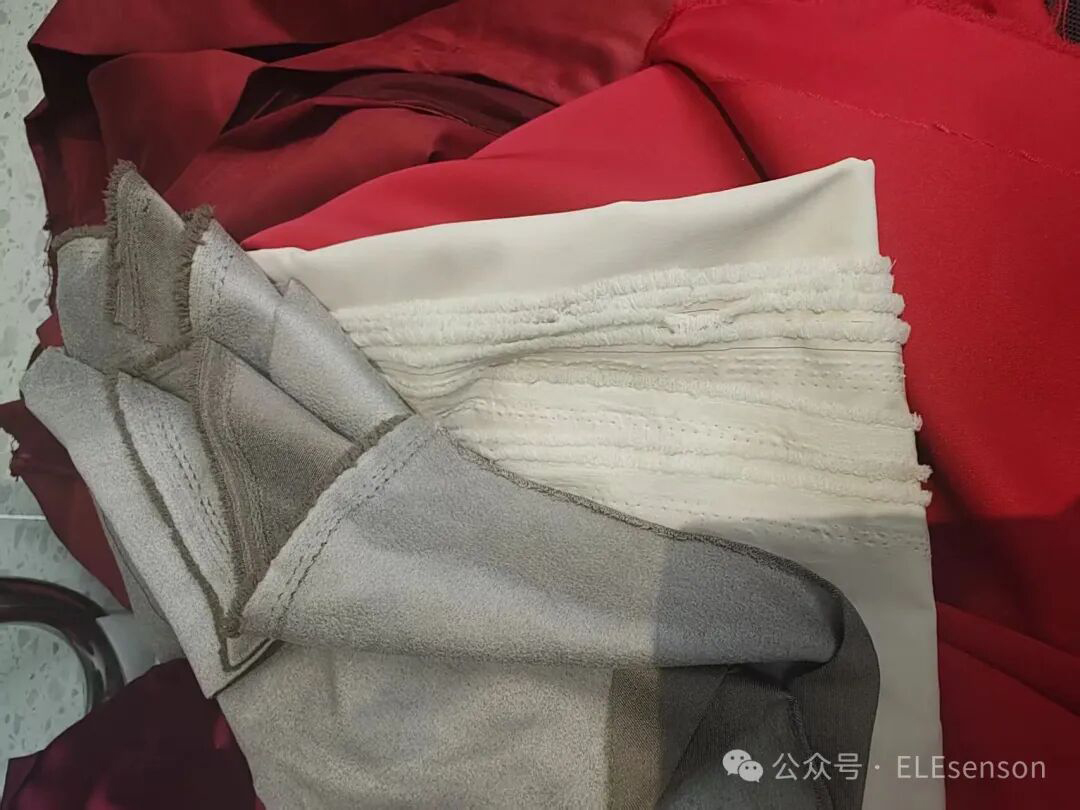
3.2 Textile Printing, Dyeing & Finished Fabric
Covers the whole process from grey fabric weaving, printing and dyeing to finished product inspection. It accurately measures grey fabric length to optimize material utilization rate, tracks printing patterns in real time to ensure printing repeat precision, and intelligently detects finished fabric defects such as color difference, missing yarn, broken warp, and stains.
3.3 Synthetic Fiber & Yarn Industry
Realizes real-time monitoring of spinning density and uniformity dynamic feedback during high-speed production. It accurately identifies broken filaments for early warning, and precisely counts winding length to standardize finished yarn quality.

04.Universal Industry Adaptation | Full-Coverage Roll Material Inspection
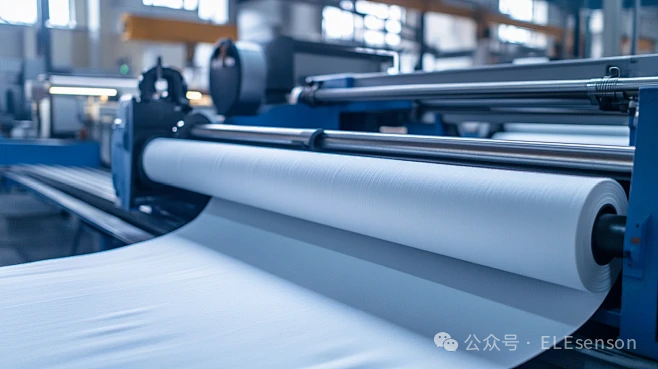
Beyond textile scenarios, the ELE vision measurement and inspection system is widely applicable to almost all flexible and rigid roll material production lines:
- Cable & Optical Fiber Industry: Precise length metering + detection of surface scratches, bulges, and insulation damage defects.
- Plastic Film Industry: Suitable for BOPP, PE and other films, detecting crystal points, fish eyes, holes and other defects while counting length.
- Metal Strip Industry: High-precision metering for steel strips, copper strips and other metal coils, identifying surface scratches and indentation defects.
- Paper Industry: Base paper length measurement + detection of holes, impurities, and tearing defects.
- Rubber & Tire Industry: Precise cord fabric length counting + joint defect detection.
05.ELE Brand Advantages | High Cost-Performance & Fast Customized Service
Compared with international brands and domestic peers, ELE visual inspection equipment features lower overall cost, faster after-sales response, iterative AI algorithms, and stronger customized adaptability, providing high-value industrial vision solutions for Chinese factories.
Comparison Item | International Brands | Domestic Major Manufacturers | ELEsenson |
Equipment Unit Price | $30,000–$100,000 | $12,000–$25,000 | $2,800–$6,800 (high cost performance) |
After-Sales Response | Long cycle, mostly paid service | 3–5 working days processing | Same-day on-site service in Zhejiang, nationwide rapid response |
Remote O&M | No remote maintenance support | Partial model support | Full series standard Bluetooth + IoT remote diagnosis & maintenance |
AI Algorithm Capability | Mature but solidified, no iteration | Basic fixed algorithm package | Continuous online iteration, higher accuracy with longer usage |
Customization Ability | Difficult to customize, low flexibility | Standard customization, average adaptability | Full-scene personalized on-demand customization |
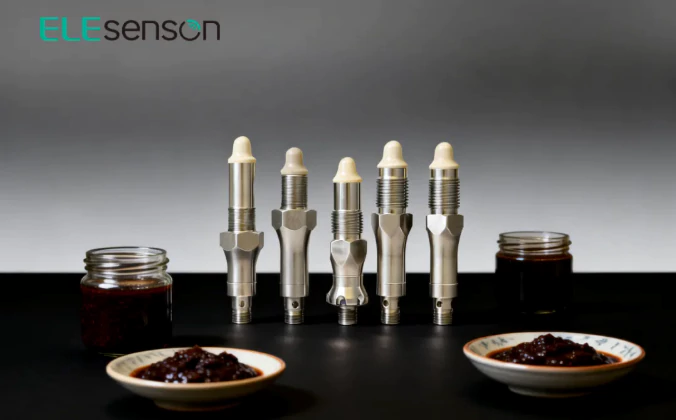
RF Admittance Level Sensor | Anti-Sticking Detection for High-Viscosity Food Sauces
In industrial storage tanks and reaction vessels handling viscous media such as adhesives, resins, asphalt, industrial coatings, and food sauces, traditional level detection faces a stubborn and long-standing pain point: false level alarms caused by probe adhesion and material residue. Unlike conventional liquid materials, high-viscosity substances easily cling to sensor probes and form a persistent coating layer. This common issue leads traditional capacitive level sensors to generate distorted data: the system displays a “full tank” status even when the tank still has vacant space, or continues to show “material present” after the tank is completely emptied. These frequent false readings trigger unplanned production shutdowns, mandatory manual tank and probe cleaning, material overflow accidents, and massive raw material waste, severely disrupting automated production stability and increasing operational costs.
ELE industrial RF admittance level sensor adopts proprietary RF admittance detection technology and innovative active shielding structure, thoroughly solving the false detection dilemma caused by viscous medium adhesion. It delivers stable, drift-free, and high-precision level monitoring for all high-viscosity, easy-adhesion working conditions, putting an end to inaccurate detection of traditional capacitive sensors.
01
Core Advantage: True Anti-Sticking & Anti-Clogging Sensing
The fundamental defect of traditional capacitive sensors is single-dimensional detection logic. Such sensors only judge the material level by capacitance value changes, failing to distinguish betweenactual medium contact and residual adhesion layer. Since both real materials and sticky residues can alter capacitance data, false alarms are inevitable in viscous medium working scenarios.
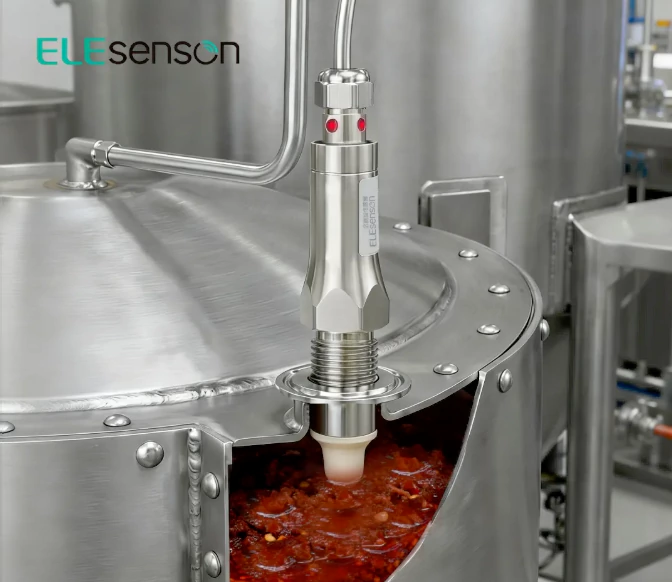
ELE RF admittance level sensor realizes disruptive upgrading through multi-dimensional RF admittance detection + equipotential active shielding electrode design. The probe adopts a dual-electrode synchronous operation structure, in which the measuring electrode and the shielding electrode maintain completely consistent potential, frequency, and phase. The system actively eliminates the interference signal generated by the surface adhesion layer, achieving exclusive identification of real material coverage at the probe tip.
No matter how strong the medium viscosity or how thick the surface adhesion layer is, the sensor output signal remains stable and accurate without drift or misjudgment. In short, probe adhesion will never interfere with effective detection — sticky residue cannot fool ELE’s professional sensing algorithm.
02
Technical Principle: Break Through Detection Limitations, See Through False Adhesion
2.1 From Single-Parameter Judgment to Multi-Dimensional Stereoscopic Detection
Traditional capacitive sensors rely solely on capacitance changes for level judgment, equivalent to “monocular observation” with a single judgment dimension. Once the probe is covered by sticky materials, the capacitance data is disordered, resulting in a sharp rise in false detection rate.
ELE RF admittance technology achieves comprehensive stereoscopic detection. It synchronously collects and analyzes three core parameters: resistance (conductance), capacitance (admittance), and phase angle difference. By comparing the comprehensive characteristic differences between real medium contact and surface residue adhesion, the system accurately filters invalid interference signals from sticky coatings and locks real material level changes. This upgrades detection from single-data judgment to full-feature material identification, fundamentally solving the adhesion interference problem.
2.2 Active Equipotential Shielding Technology: Zero Interference from Adhesion Layer
As the core black technology of anti-sticking detection, active driven shielding technology completely subverts the single-electrode structure of traditional sensors. The ELE sensor probe adopts a three-terminal integrated structure, including a central measuring electrode, a coaxial shielding electrode, and a driving terminal.
The measuring electrode and the shielding electrode transmit high-frequency RF signals synchronously with equal potential and identical phase. Since there is no potential difference between the two electrodes, the adhered sticky medium cannot form effective current conduction, and the adhesion layer loses all interference impact on measurement data. This realizes the professional detection logic of adhesion accumulates on the probe, while measurement remains completely accurate.
Meanwhile, the synchronous in-phase shielding layer forms a stable electrostatic isolation barrier, which shields external environmental interference and residual capacitance influence, focusing all detection accuracy on the real material level changes inside the tank.
03
Industrial Verification: Powerful Data Proves Stable Performance
3.1 Ultra-Low False Alarm Rate, Far Exceeding Traditional Sensors
In professional laboratory tests targeting high-viscosity asphalt medium (viscosity up to 5000 mPa·s), the ELE RF admittance level sensor achieves afalse alarm rate lower than 0.1%, with less than one misjudgment in 1000 detection cycles. In contrast, traditional capacitive sensors have a false alarm rate as high as 20%–30% under the same working conditions, unable to meet continuous and stable production requirements.
3.2 Greatly Improved Detection Accuracy, Reducing Material Waste
A large chemical plant’s adhesive and resin storage tanks once suffered from overflow losses caused by low detection accuracy. Traditional transmitters had a measurement error of ±5%, leading to frequent material overflow and raw material waste. After replacing with ELE RF admittance level sensors, the detection error was optimized to ±0.5%, reducing annual raw material loss by more than 1 million RMB and effectively improving production benefits.
3.3 70%+ Reduction in Maintenance Downtime
For cement plant pulverized coal silos and damp powder storage equipment, traditional sensors require weekly shutdown cleaning due to easy adhesion of damp materials. After adopting ELE RF admittance sensors, the shutdown frequency caused by adhesion false alarms is reduced by more than 70%. It eliminates frequent manual cleaning and equipment downtime, realizing long-term unattended stable operation of the production line.
04
Product Core Features & Industrial Advantages
Relying on years of industrial sensor R&D and manufacturing experience, ELE specially designs RF admittance level sensors for high-viscosity, easy-adhesion, and harsh industrial media, covering chemical, food, building materials, and environmental protection industries.
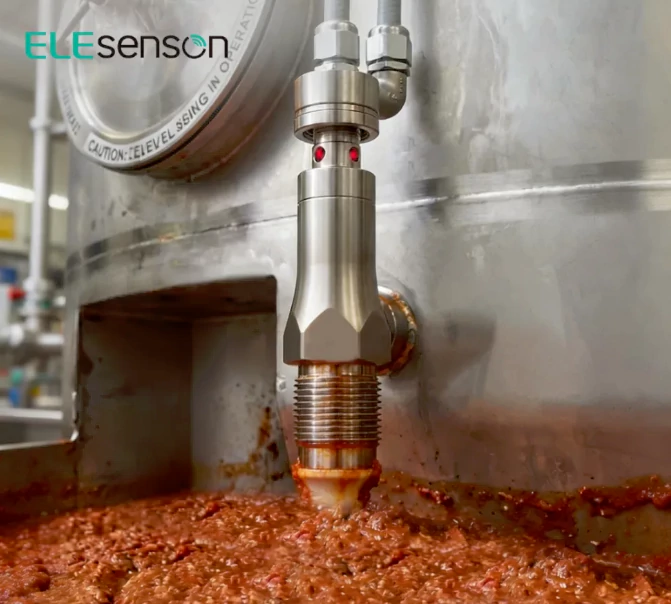
- Industry-Leading Anti-Adhesion Performance: Combining multi-dimensional admittance measurement and active shielding technology, it maintains accurate detection even when the probe is fully covered by sticky media, completely free from residue interference.
- Ultra-Wide Medium Compatibility: Applicable to all media with dielectric constant ≥1.6, including conductive liquid, non-conductive liquid, viscous slurry, asphalt, ink, glue, and food sauce, with strong scene adaptability.
- Maintenance-Free Electronic Design: No mechanical moving parts, zero mechanical wear, no need for regular manual probe cleaning, greatly reducing later operation and maintenance costs.
- Extreme Environmental Adaptability: Supports -40℃ to 200℃ wide temperature operation, withstands up to 10 MPa pressure, and features IP66/IP67 high-level protection, adapting to high-temperature, high-pressure, dusty, and humid harsh workshop environments.
- Intelligent & Easy Integration: Supports 4–20mA analog signal, digital switch output, and HART protocol. It can be seamlessly connected with PLC and DCS systems to realize automatic feeding, high/low level alarm, and intelligent inventory management.
05
Typical Industrial Application Scenarios
- Adhesive & Glue Storage Tanks: Realizes high and low liquid level alarm, tank overflow prevention, and empty pump protection to ensure safe and stable glue supply.
- Resin & Polymer Reaction Kettles: Continuously monitors material level changes during chemical reactions, supporting precise process control.
- Asphalt, Heavy Oil, Ink & Coating Tanks: Solves detection difficulties of high-temperature and high-viscosity media, avoiding false alarms caused by thick adhesion layers.
- Food Grade Sauce & Syrup Tanks: Provides stable and reliable level detection for viscous food materials, meeting sanitary production requirements.
06
Conclusion
For viscous medium production lines that are prone to adhesion and residue, level detection accuracy directly determines production safety, yield and maintenance cost. ELE RF admittance level sensor completely solves the industry pain point of adhesion false detection through active shielding technology and multi-dimensional sensing logic. It avoids material overflow, production shutdown and manual cleaning losses, becoming a reliable stable detection anchor for viscous medium industrial scenarios.
ELE RF Admittance Level Sensor: The Stickier the Medium, the More Accurate the Detection.
Contact ELE Sensor for free sample testing and professional technical selection support to customize exclusive level detection solutions for your working conditions.
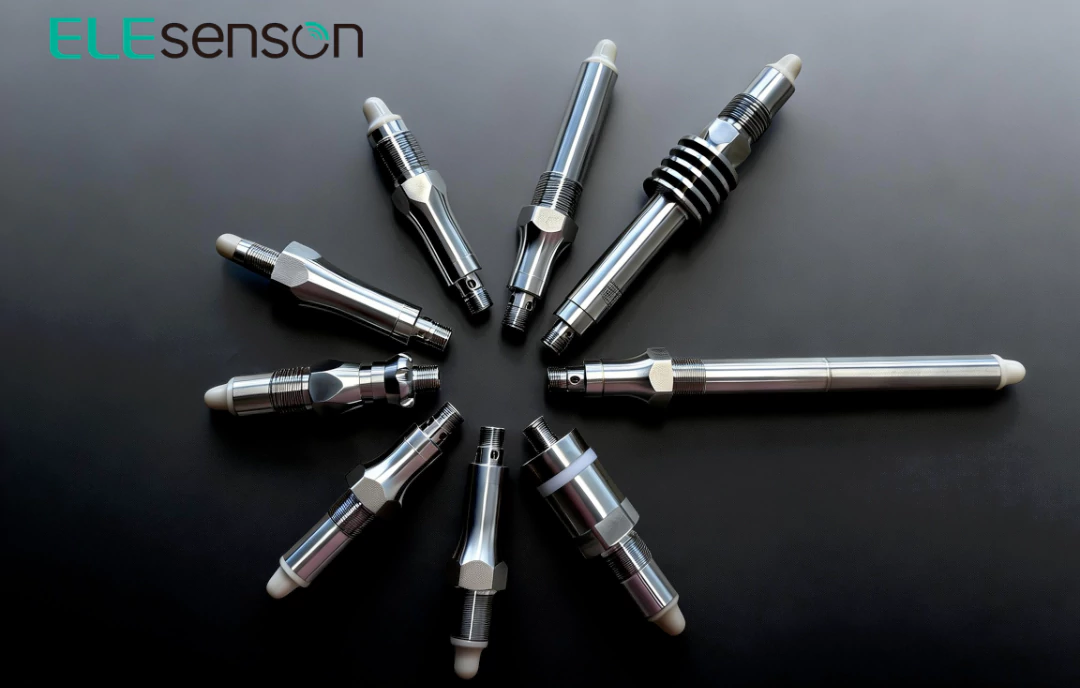
RF Admittance Level Sensor | Professional Anti-Sticking Detection for Viscous Media
In industrial storage tanks and reaction vessels handling viscous media such as adhesives, resins, asphalt, industrial coatings, and food sauces, traditional level detection faces a stubborn and long-standing pain point: false level alarms caused by probe adhesion and material residue. Unlike conventional liquid materials, high-viscosity substances easily cling to sensor probes and form a persistent coating layer. This common issue leads traditional capacitive level sensors to generate distorted data: the system displays a “full tank” status even when the tank still has vacant space, or continues to show “material present” after the tank is completely emptied. These frequent false readings trigger unplanned production shutdowns, mandatory manual tank and probe cleaning, material overflow accidents, and massive raw material waste, severely disrupting automated production stability and increasing operational costs.
ELE industrial RF admittance level sensor adopts proprietary RF admittance detection technology and innovative active shielding structure, thoroughly solving the false detection dilemma caused by viscous medium adhesion. It delivers stable, drift-free, and high-precision level monitoring for all high-viscosity, easy-adhesion working conditions, putting an end to inaccurate detection of traditional capacitive sensors.
01. Core Advantage: True Anti-Sticking & Anti-Clogging Sensing
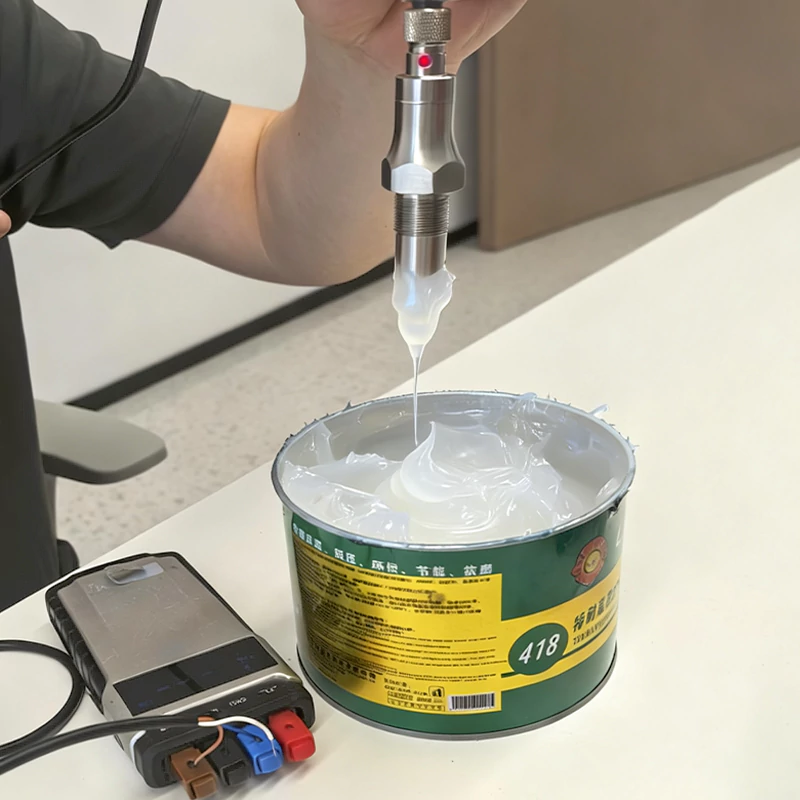
The fundamental defect of traditional capacitive sensors is single-dimensional detection logic. Such sensors only judge the material level by capacitance value changes, failing to distinguish betweenactual medium contact and residual adhesion layer. Since both real materials and sticky residues can alter capacitance data, false alarms are inevitable in viscous medium working scenarios.
ELE RF admittance level sensor realizes disruptive upgrading through multi-dimensional RF admittance detection + equipotential active shielding electrode design. The probe adopts a dual-electrode synchronous operation structure, in which the measuring electrode and the shielding electrode maintain completely consistent potential, frequency, and phase. The system actively eliminates the interference signal generated by the surface adhesion layer, achieving exclusive identification of real material coverage at the probe tip.
No matter how strong the medium viscosity or how thick the surface adhesion layer is, the sensor output signal remains stable and accurate without drift or misjudgment. In short, probe adhesion will never interfere with effective detection — sticky residue cannot fool ELE’s professional sensing algorithm.
02. Technical Principle: Break Through Detection Limitations, See Through False Adhesion
2.1 From Single-Parameter Judgment to Multi-Dimensional Stereoscopic Detection
Traditional capacitive sensors rely solely on capacitance changes for level judgment, equivalent to “monocular observation” with a single judgment dimension. Once the probe is covered by sticky materials, the capacitance data is disordered, resulting in a sharp rise in false detection rate.
ELE RF admittance technology achieves comprehensive stereoscopic detection. It synchronously collects and analyzes three core parameters: resistance (conductance), capacitance (admittance), and phase angle difference. By comparing the comprehensive characteristic differences between real medium contact and surface residue adhesion, the system accurately filters invalid interference signals from sticky coatings and locks real material level changes. This upgrades detection from single-data judgment to full-feature material identification, fundamentally solving the adhesion interference problem.
2.2 Active Equipotential Shielding Technology: Zero Interference from Adhesion Layer
As the core black technology of anti-sticking detection, active driven shielding technology completely subverts the single-electrode structure of traditional sensors. The ELE sensor probe adopts a three-terminal integrated structure, including a central measuring electrode, a coaxial shielding electrode, and a driving terminal.
The measuring electrode and the shielding electrode transmit high-frequency RF signals synchronously with equal potential and identical phase. Since there is no potential difference between the two electrodes, the adhered sticky medium cannot form effective current conduction, and the adhesion layer loses all interference impact on measurement data. This realizes the professional detection logic of adhesion accumulates on the probe, while measurement remains completely accurate.
Meanwhile, the synchronous in-phase shielding layer forms a stable electrostatic isolation barrier, which shields external environmental interference and residual capacitance influence, focusing all detection accuracy on the real material level changes inside the tank.
03. Industrial Verification: Powerful Data Proves Stable Performance
3.1 Ultra-Low False Alarm Rate, Far Exceeding Traditional Sensors
In professional laboratory tests targeting high-viscosity asphalt medium (viscosity up to 5000 mPa·s), the ELE RF admittance level sensor achieves afalse alarm rate lower than 0.1%, with less than one misjudgment in 1000 detection cycles. In contrast, traditional capacitive sensors have a false alarm rate as high as 20%–30% under the same working conditions, unable to meet continuous and stable production requirements.
3.2 Greatly Improved Detection Accuracy, Reducing Material Waste
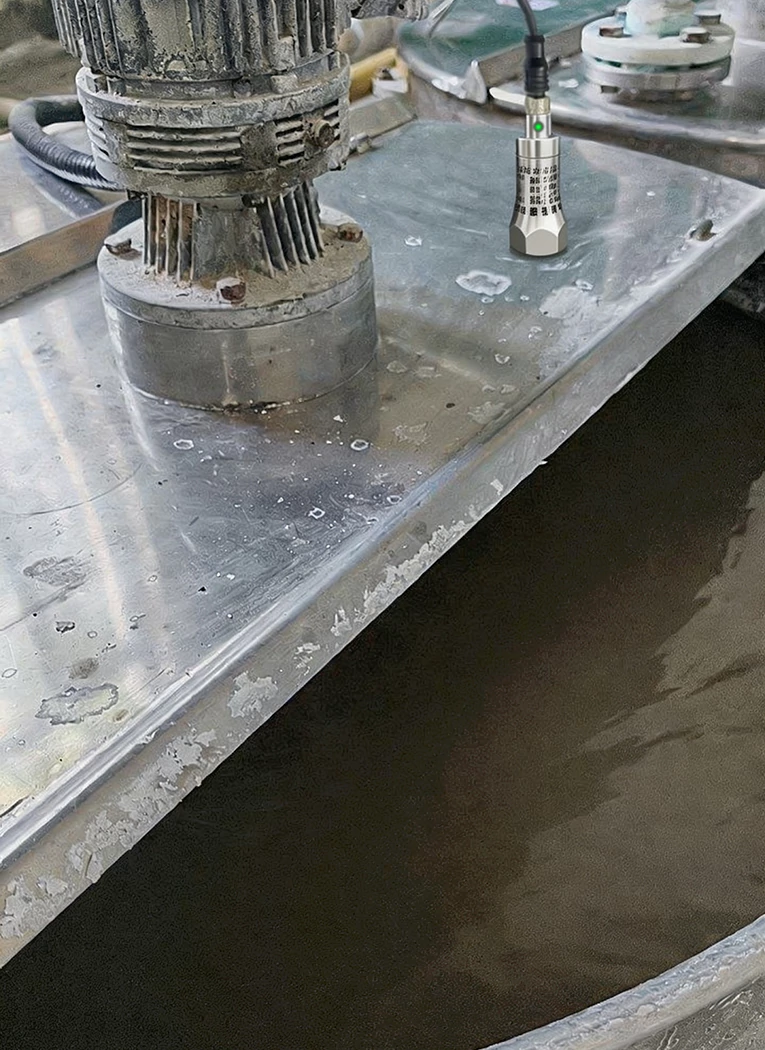
A large chemical plant’s adhesive and resin storage tanks once suffered from overflow losses caused by low detection accuracy. Traditional transmitters had a measurement error of ±5%, leading to frequent material overflow and raw material waste. After replacing with ELE RF admittance level sensors, the detection error was optimized to ±0.5%, reducing annual raw material loss by more than 1 million RMB and effectively improving production benefits.
3.3 70%+ Reduction in Maintenance Downtime
For cement plant pulverized coal silos and damp powder storage equipment, traditional sensors require weekly shutdown cleaning due to easy adhesion of damp materials. After adopting ELE RF admittance sensors, the shutdown frequency caused by adhesion false alarms is reduced by more than 70%. It eliminates frequent manual cleaning and equipment downtime, realizing long-term unattended stable operation of the production line.
04. Product Core Features & Industrial Advantages
Relying on years of industrial sensor R&D and manufacturing experience, ELE specially designs RF admittance level sensors for high-viscosity, easy-adhesion, and harsh industrial media, covering chemical, food, building materials, and environmental protection industries.
- Industry-Leading Anti-Adhesion Performance: Combining multi-dimensional admittance measurement and active shielding technology, it maintains accurate detection even when the probe is fully covered by sticky media, completely free from residue interference.
- Ultra-Wide Medium Compatibility: Applicable to all media with dielectric constant ≥1.6, including conductive liquid, non-conductive liquid, viscous slurry, asphalt, ink, glue, and food sauce, with strong scene adaptability.
- Maintenance-Free Electronic Design: No mechanical moving parts, zero mechanical wear, no need for regular manual probe cleaning, greatly reducing later operation and maintenance costs.
- Extreme Environmental Adaptability: Supports -40℃ to 200℃ wide temperature operation, withstands up to 10 MPa pressure, and features IP66/IP67 high-level protection, adapting to high-temperature, high-pressure, dusty, and humid harsh workshop environments.
- Intelligent & Easy Integration: Supports 4–20mA analog signal, digital switch output, and HART protocol. It can be seamlessly connected with PLC and DCS systems to realize automatic feeding, high/low level alarm, and intelligent inventory management.
05. Typical Industrial Application Scenarios
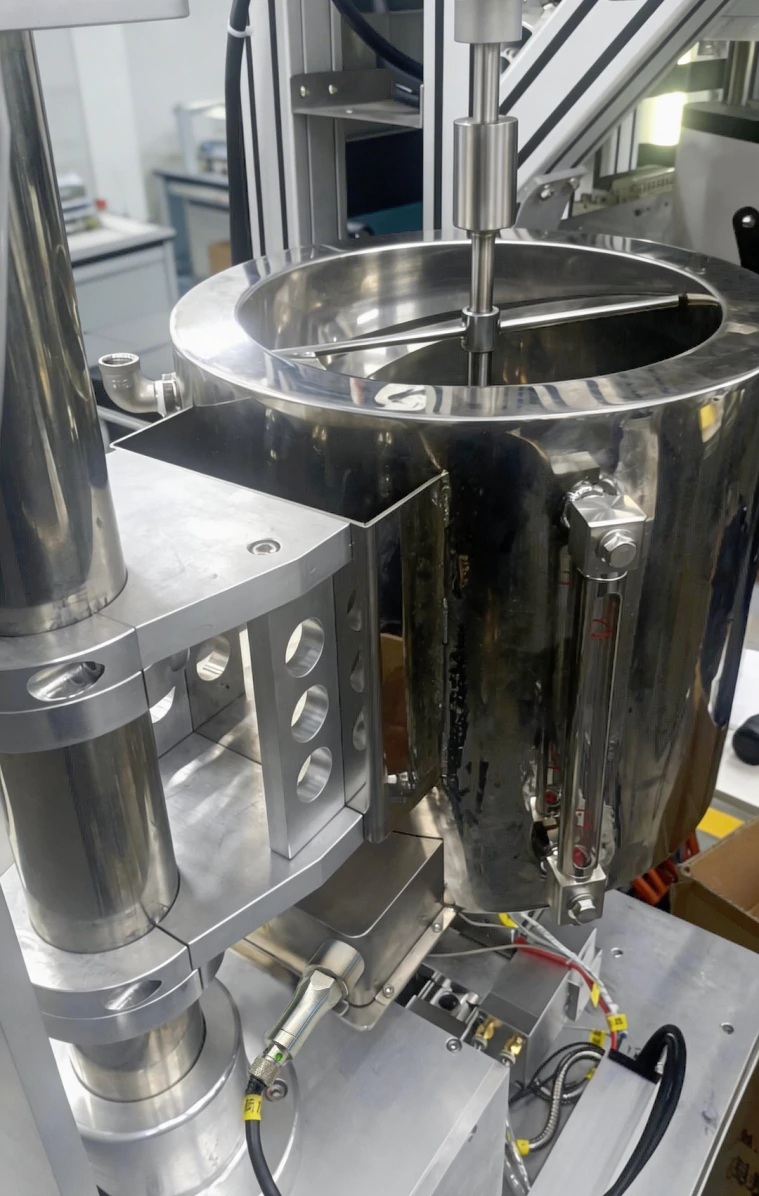
- Adhesive & Glue Storage Tanks: Realizes high and low liquid level alarm, tank overflow prevention, and empty pump protection to ensure safe and stable glue supply.
- Resin & Polymer Reaction Kettles: Continuously monitors material level changes during chemical reactions, supporting precise process control.
- Asphalt, Heavy Oil, Ink & Coating Tanks: Solves detection difficulties of high-temperature and high-viscosity media, avoiding false alarms caused by thick adhesion layers.
- Food Grade Sauce & Syrup Tanks: Provides stable and reliable level detection for viscous food materials, meeting sanitary production requirements.
Conclusion
For viscous medium production lines that are prone to adhesion and residue, level detection accuracy directly determines production safety, yield and maintenance cost. ELE RF admittance level sensor completely solves the industry pain point of adhesion false detection through active shielding technology and multi-dimensional sensing logic. It avoids material overflow, production shutdown and manual cleaning losses, becoming a reliable stable detection anchor for viscous medium industrial scenarios.
ELE RF Admittance Level Sensor: The Stickier the Medium, the More Accurate the Detection.
Contact ELE Sensor for free sample testing and professional technical selection support to customize exclusive level detection solutions for your working conditions.
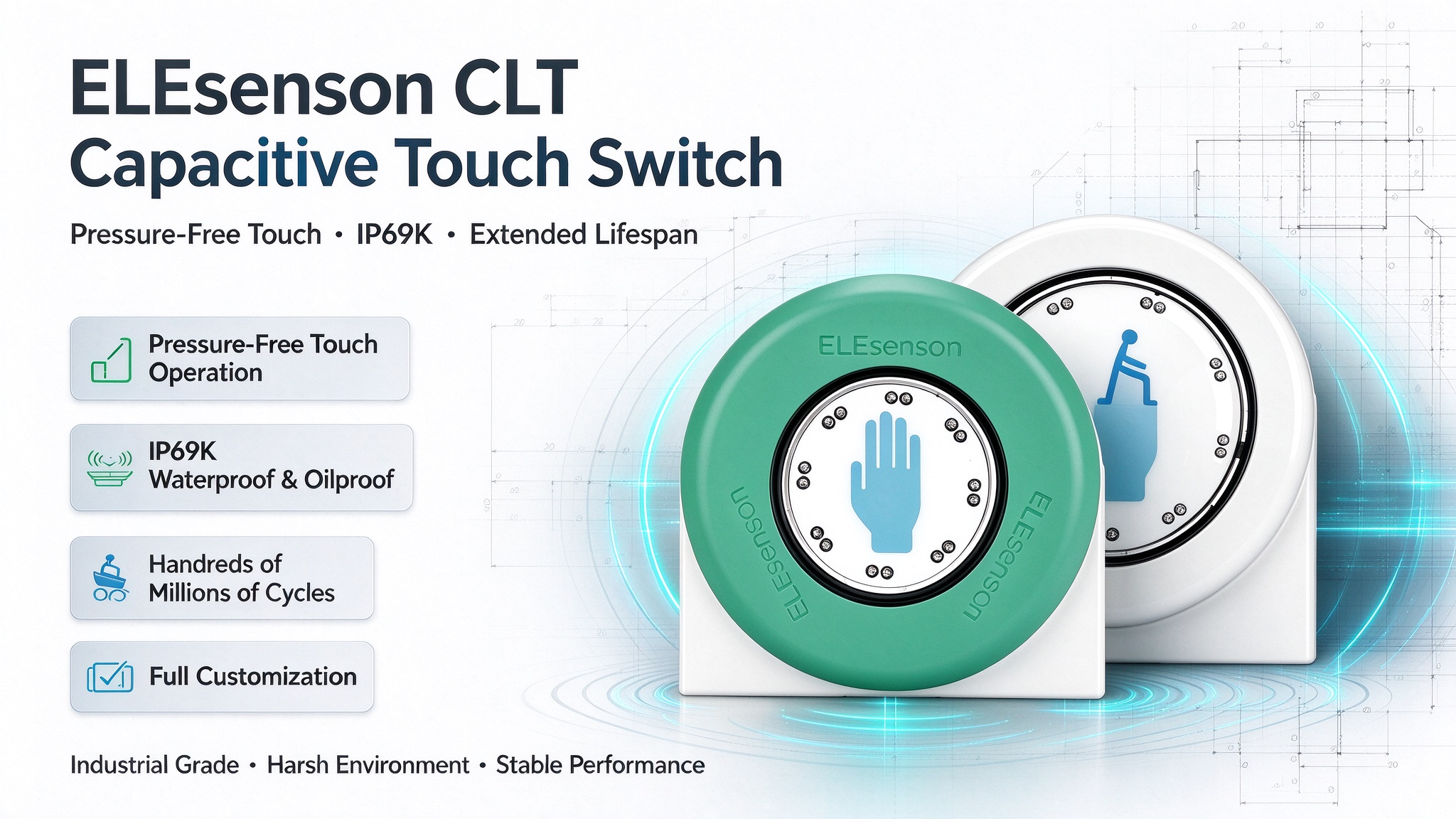
Industrial Capacitive Touch Switch | IP69K Waterproof & Dustproof, High Durability
ELEsenson industrial capacitive touch switch adopts advanced capacitive sensing technology, delivering pressure-free sensitive touch operation, ultra-long service life and outstanding structural durability. Built with integrated molding craftsmanship and premium industrial-grade materials, this CLT series touch switch features full waterproof, oil-proof and dustproof performance. It can operate stably in extremely harsh workshop environments and adapt to various extreme weather conditions, effectively resisting water immersion, oil contamination and dust erosion for long-term continuous operation.
The ELEsenson CLT capacitive touch switch series supports highly diversified configurations, including multiple panel sizes, housing materials, wiring methods, mounting depths, accessories and standardized customized options. It covers almost all industrial application scenarios. Specifically, the stainless steel and tempered glass housing versions meet high-level hygiene standards, making them perfectly suitable for stringent industries such as medical healthcare, food processing and beverage production.
Core Product Features
Pressure-Free Capacitive Touch Operation
Adopts high-precision capacitive induction design, realizing sensitive pressure-free touch control. The operation is smooth and labor-saving with no mechanical pressing wear, bringing stable and responsive user experience for automated equipment operation.
Ultra-High Mechanical Durability
Designed for industrial long-term use, the switch supports up to hundreds of millions of switching cycles. It far exceeds the service life of traditional mechanical buttons, greatly reducing equipment failure rate and replacement frequency.
Rich Diversified Custom Options
Supports flexible selection of touch surface size, housing material, panel pattern and aesthetic design. It matches diverse equipment styles and installation requirements, realizing personalized adaptation for different industrial machines.
IP69K High-Level Water & Oil Resistance
Adopts one-piece integrated molding process with seamless structural design. It achieves top-tier IP69K ingress protection, fully resistant to high-pressure water flushing, oil pollution and dust accumulation, ideal for wet, dusty and oily harsh industrial environments.
Strong Impact & Damage Resistance
The tempered glass and metal housing structure delivers excellent flame resistance, impact resistance and vandal-proof performance. It can withstand external mechanical collisions and accidental damage, ensuring stable operation in complex on-site conditions.
Multi-Dimensional Humanized Feedback
Equipped with triple feedback mechanisms: 16 high-brightness LED indicator lights (8 green + 8 red), buzzer audible prompt and vibration haptic feedback. It provides clear working status reminders for operators in noisy or dark working environments.
Full-Scale Customization Service
Supports custom logo printing, personalized panel patterns, adjustable sensitivity and brightness. We provide one-stop customized solutions to meet personalized brand and equipment matching needs for different customers.
Technical Specifications
|
Item |
Technical Specifications |
|
Operating Voltage |
DC 24 V (16.8V ~ 32V Wide Voltage) |
|
Permissible Current |
Max. 200 mA |
|
Output Type |
PNP-NO Normally Open Output |
|
Output Signal |
Continuous signal output after activation |
|
LED Indicators |
8 Pcs Green LEDs + 8 Pcs Red LEDs (16 LEDs in total) |
|
Reverse Polarity Protection |
Full-wire reverse misconnection protection |
|
Short-circuit & Overload Protection |
Built-in short-circuit and overload self-protection function |
|
Voltage Drop |
Max. 2.5 V @ 200 mA Load |
|
Current Consumption |
Max. 30 mA @ DC 24 V |
|
Operating Temperature |
-30℃ ~ +80℃ Wide Temperature Range |
|
Ingress Protection Grade |
IP69K (Touch Operating Area) |
|
Working Principle |
Capacitive Sensing |
|
Operation Mode |
Pressure-free Touch Actuation |
|
Sensitivity |
Customizable & Adjustable |
|
LED Brightness |
Customizable & Adjustable |
|
Panel Pattern |
Customizable |