

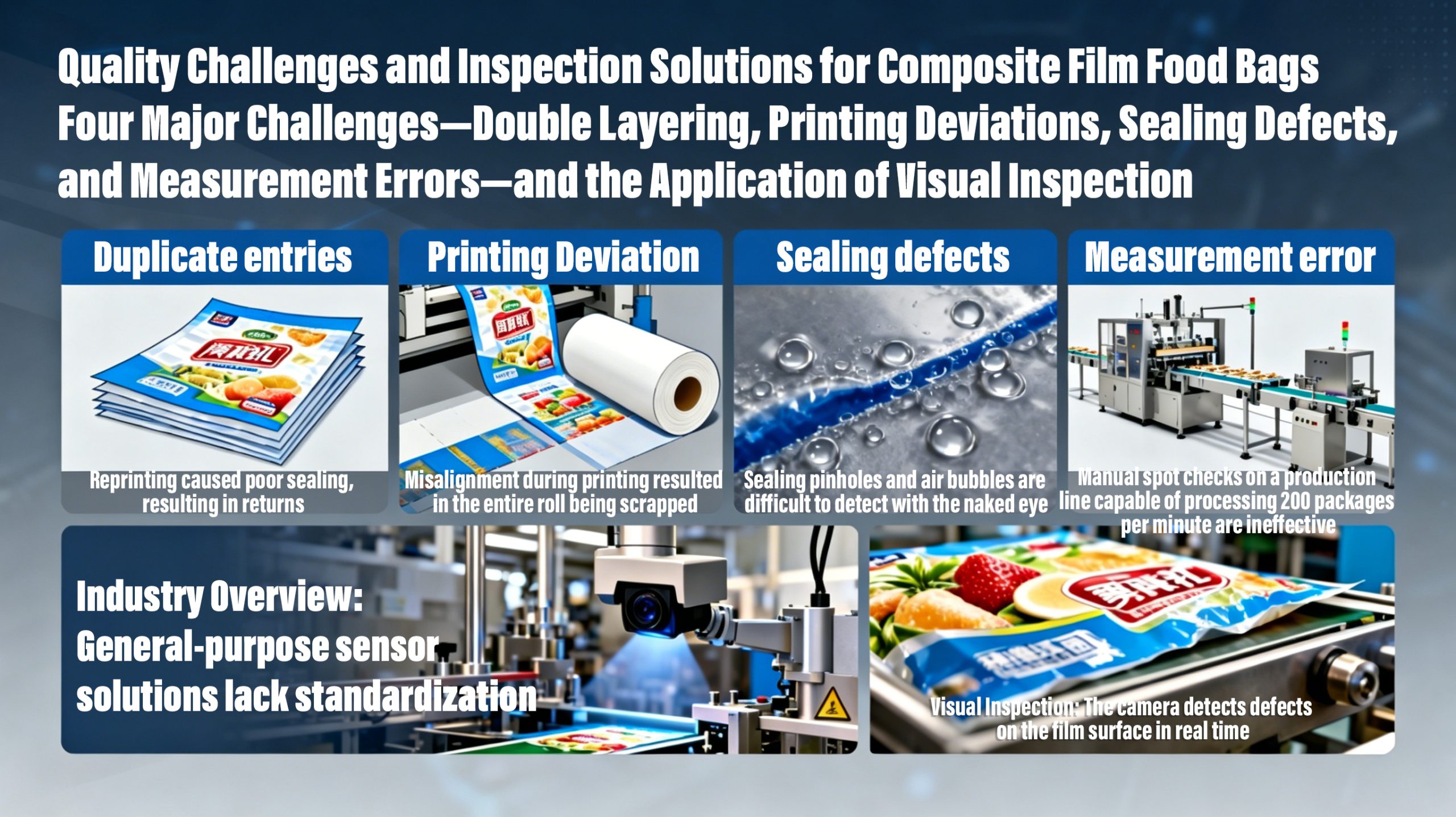
Food Packaging Inspection System | All-in-One Vision Detection for Composite Film Bags
Food packaging safety is the final safety barrier of the food industry and the core cornerstone of consumer trust. In the mass production of composite film food packaging bags, various invisible quality defects frequently occur, including film layer overlapping, printing misalignment, sealing damage, and metering errors. These hidden problems easily trigger after-sales returns, batch scrapping, and food safety risks, becoming a key pain point restricting standardized quality control for packaging enterprises.
For a long time, quality control engineers and bag manufacturers have been plagued by persistent packaging quality issues. Composite bag delamination and double-layer lamination lead to poor sealing and customer returns; printing registration deviation causes entire roll material scrapping and massive raw material waste; tiny pinholes, hidden bubbles and sealing cracks are difficult to capture by naked eyes. Especially for high-speed production lines with a speed of 200 bags per minute, traditional manual sampling inspection is completely ineffective with extremely high missing detection rates. The industry has long relied on patched, general-purpose sensor solutions, lacking professional, systematic, and standardized composite film inspection equipment.
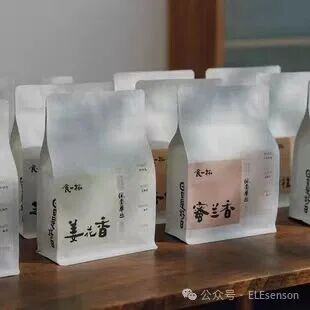
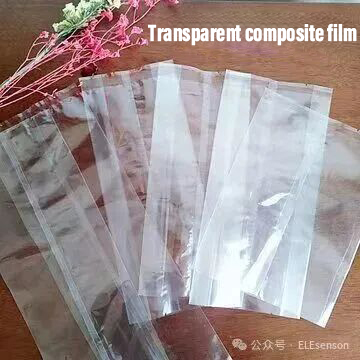
01.Industry Pain Points | General Sensors Fail to Adapt to Composite Film Inspection Scenarios
At present, composite film food bag quality inspection is still in a “makeshift alternative” stage. Conventional universal sensors have inherent technical defects in targeted detection scenarios and cannot form closed-loop quality control, resulting in unresolvable quality risks:
- Reflective Photoelectric Sensors: Prone to frequent false triggering and invalid signal output when detecting metallized composite film layers, unable to achieve stable and reliable layer identification.
- Ultrasonic Single/Double Sheet Sensors: Limited by working principle resolution, it cannot accurately distinguish layer differences such as 2-layer and 4-layer composite films, resulting in inaccurate double-layer anomaly identification.
- Metal Eddy Current Detectors: Only applicable to packaging bags containing metal layers, with extremely narrow application scenarios; unable to detect printing, sealing and other comprehensive defects synchronously.
- Manual Visual Inspection: High false-negative and missing inspection rates, unable to match the inspection rhythm of high-speed production lines, bringing long-term hidden dangers to factory quality control.
Although imported brands occupy the mainstream market of general industrial sensors, there are no targeted customized solutions for composite film food packaging scenarios. Most domestic manufacturers only produce single-function imitation equipment, resulting in a typical industry dilemma of“market demand exists but professional solutions are missing”. Most factories can only refer to peer experience for procurement, but the universal ultrasonic and photoelectric solutions searched on the market cannot adapt to composite bag detection. After repeated testing and failure, enterprises have to passively tolerate quality risks due to no alternative equipment.
02.ELE Innovative Breakthrough | All-in-One Vision System Reshapes Composite Film Quality Control Standards
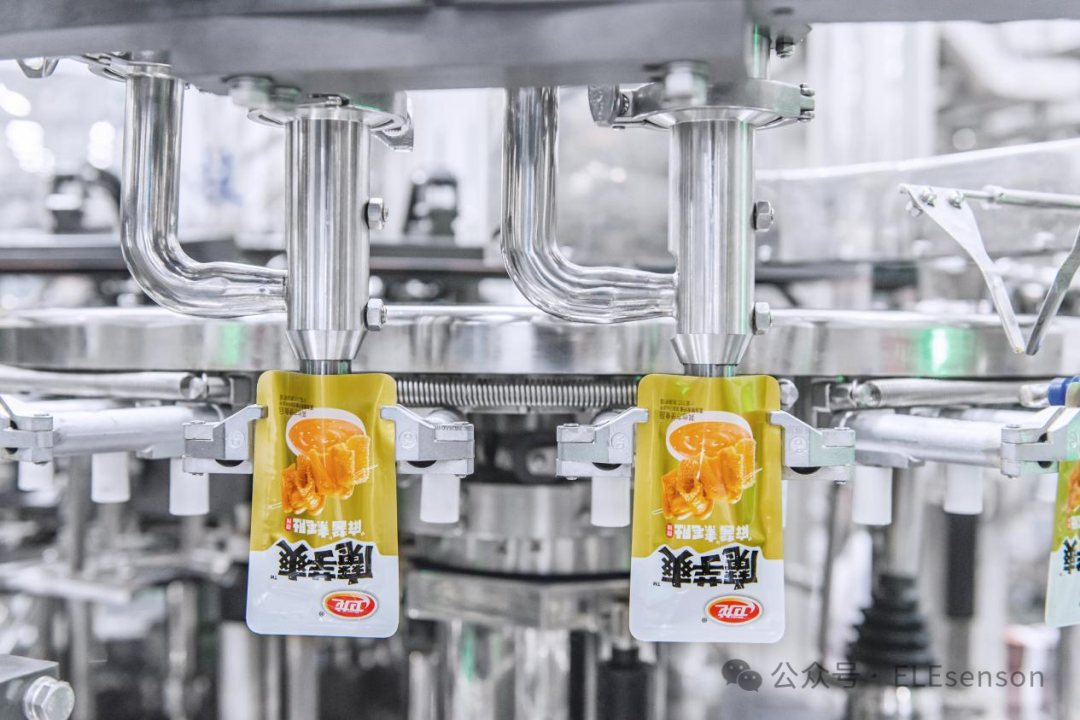
Focusing on industrial machine vision inspection technology, ELE thoroughly breaks the industry’s long-term reliance on fragmented single-function sensors. We independently launch a full-functional composite film food packaging vision inspection system, integrating four core detection modules: double-layer film lamination detection, printing registration deviation inspection, sealing defect identification, and precise length metering. Based on a unified vision hardware platform, it realizes one-machine multi-purpose and full-dimensional full-inspection quality control for food packaging.
Core Function & Customer Value Matrix
Function Modules | Core Customer Value | Market Demand Matching |
Composite Film Lamination Detection (2-Layer/4-Layer Identification) | Effectively solve poor sealing caused by abnormal lamination, reduce product return rates and after-sales disputes | Industry pain points are prominent with no mature solutions; strong rigid market demand |
Printing Registration Inspection | Avoid batch scrapping of printed packaging materials and greatly reduce raw material waste costs | Highly matched, directly related to enterprise production cost control |
Sealing Defect Detection | Accurately identify tiny pinholes, bubbles, sealing cracks and other hidden defects to ensure food packaging safety | Mandatory demand for food safety compliance, preventing safety accidents caused by defective sealing |
Precision Length & Meter Counting | Guarantee accurate packaging material metering, avoid short weight problems, and ensure batch production consistency | Meet supermarket sampling inspection and customer compliance acceptance standards |
Four-in-One Integrated Advantage | Replace multiple independent detection devices, reduce 80% of equipment procurement and docking costs, and improve debugging efficiency | Solve the core pain of multi-equipment compatibility and multi-supplier management confusion |
Scenario Adaptation Advantages
ELE integrated vision inspection system is precisely customized for the actual production scenarios of food packaging factories and bag-making equipment manufacturers, with strong scene adaptability and practicality:
- Integrated design eliminates the need for repeated installation of multiple sensors on the production line, simplifying equipment wiring and reducing installation and commissioning costs.
- Unified inspection platform and data output realize centralized statistics, traceability and management of all packaging quality defects.
- Specially optimized vision algorithms for composite film features completely solve the misjudgment and missed detection problems of traditional ultrasonic and photoelectric sensors, greatly improving detection accuracy and stability.
- Fully adapts to high-speed production lines of 200 bags per minute and above, realizing 100% full inspection instead of traditional sampling inspection, completely eliminating defect leakage risks.
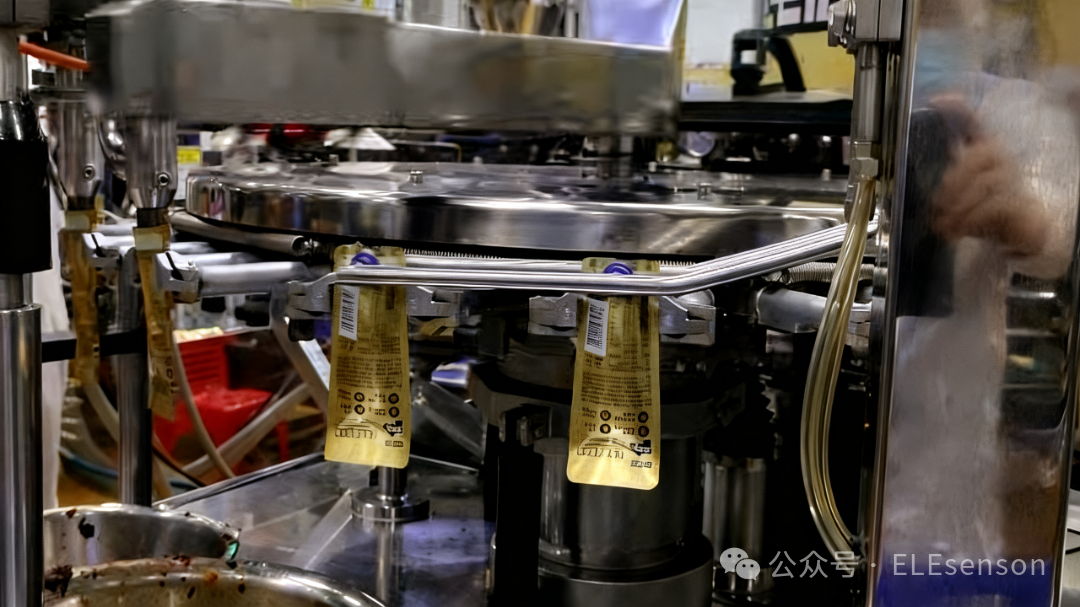
03.Market Value Upgrade | From Single Sensor Sales to Systematic Quality Control Solutions
According to industry market data, the separate procurement cost of traditional single-function detection equipment is extremely high: standalone double-layer detection equipment costs 5,000–8,000 RMB, printing registration detection 8,000–15,000 RMB, sealing defect detection 6,000–12,000 RMB, and meter counting equipment 3,000–8,000 RMB. Purchasing multiple devices separately will not only generate huge procurement costs, but also bring many problems such as inconsistent system protocols, difficult compatibility docking, complicated later maintenance, and scattered after-sales resources.
ELE all-in-one food packaging vision inspection system integrates the four core detection functions in one device, with a comprehensive pricing of 20,000–35,000 RMB. It realizes one-time procurement, full-scene quality control, effectively reducing customers’ comprehensive procurement, operation and maintenance costs.
This innovative model completely changes the industry’s traditional sales logic of “selling single sensors”. Instead, ELE provides targeted and systematic full-process quality control solutions for composite film food packaging enterprises, helping factories achieve intelligent, standardized and low-cost quality upgrading.

elesenson
ELEsenson is a company specializing in the research, development, production, and sales of sensor technology, located in Wenzhou, Zhejiang, China. Upholding the corporate philosophy of “striving for perfection and pursuing excellence,” the company is committed to providing precise and reliable sensor solutions to customers worldwide. The company boasts an experienced R&D team dedicated to the research and development of cutting-edge sensor technologies. ELEsenon not only prioritizes product quality but also places a strong emphasis on customer needs. Production strictly adheres to international quality management system standards, ensuring that every product meets or exceeds customer expectations. Moving forward, Zhejiang ELEsenon will continue to pursue technological innovation and uphold the principle of quality first, striving to become a global leader in the sensor industry and providing customers with superior products and attentive service.