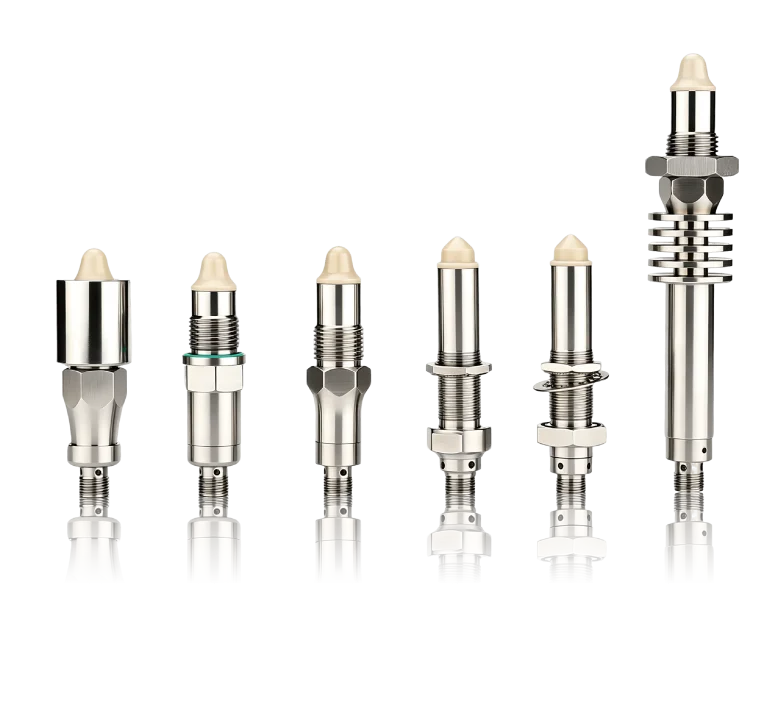
ESP Series Bluetooth Sweep-Frequency Level Sensor | 3-Second Wireless Tuning
High-end imported level switches feature high precision and stable performance, yet they come with exorbitant pricing, long delivery cycles of several months, and sluggish multi-level distributor after-sales support. While conventional domestic level sensors offer lower procurement costs, they suffer from prevalent drawbacks including material adhesion limitations, poor medium compatibility, and complicated on-site commissioning. Frequent false alarms lead to increased failure rates and continuously rising maintenance costs, failing to meet modern industrial stable monitoring demands.
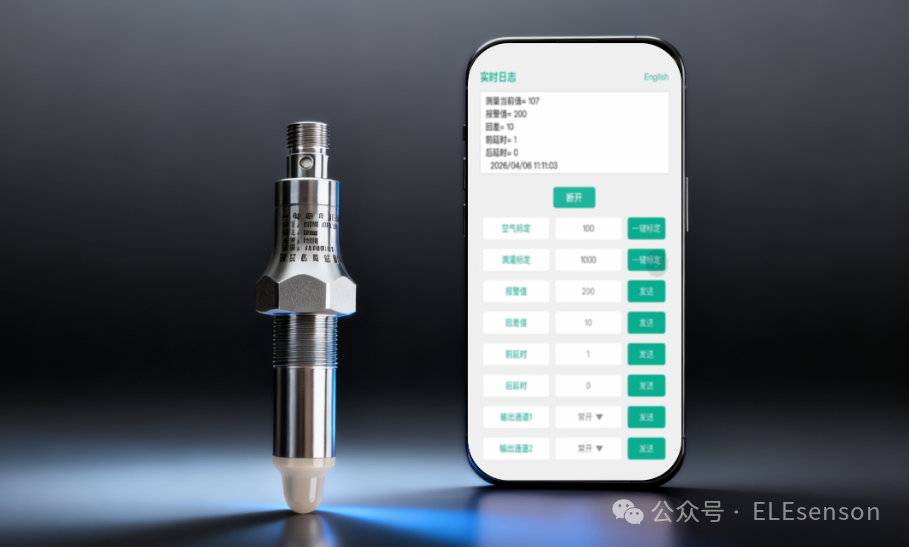
The industry has long faced an awkward dilemma: choosing between expensive international high-stability instruments and low-cost domestic sensors with unreliable performance. ELEsenson’s newly launched ESP Series Bluetooth Sweep-Frequency Level Sensor perfectly breaks this industry bottleneck. Boasting core detection performance comparable to top international brands such as IFM and Baumer, it delivers premium-grade stability at a cost-effective domestic price point. Equipped with exclusive Bluetooth wireless tuning technology, it thoroughly solves various pain points of traditional cumbersome on-site commissioning
01.3-Second Wireless Tuning | No Height Climbing, No Disassembly Required
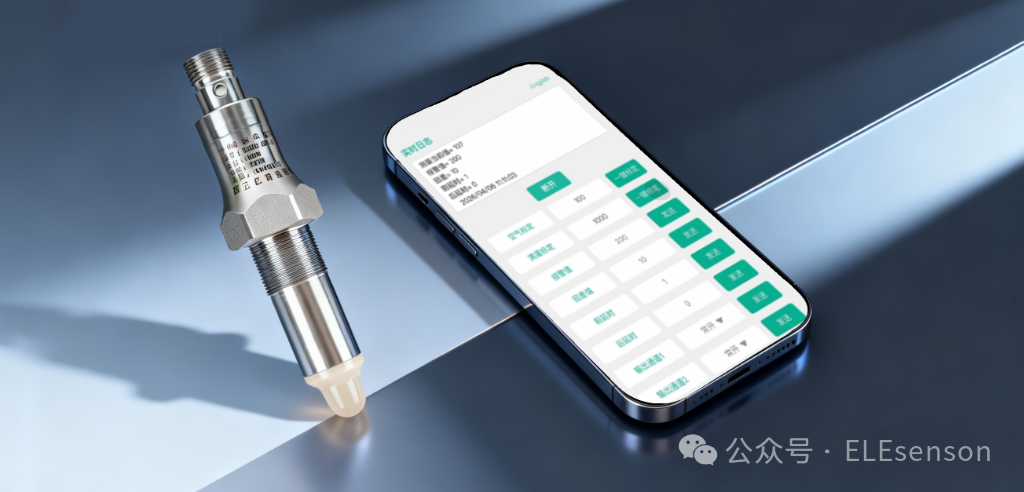
Traditional level sensor commissioning is a major burden for on-site O&M teams. Most sensors are installed on high-altitude equipment such as material silos, storage tanks, and reaction kettles. Conventional debugging requires climbing ladders, disassembling equipment housings, and manually adjusting internal potentiometers with screwdrivers. Operators must repeatedly climb up and down to verify parameters, with each calibration process taking 15–20 minutes.
Parameter recalibration is frequently required after production material switching, ambient temperature changes, or probe surface adhesion and dust accumulation, bringing persistent high-altitude operation safety risks. Additionally, frequent equipment disassembly is prohibited in food cleanrooms and explosion-proof chemical workshops, as it easily causes environmental contamination and potential safety hazards. Production line shutdown for debugging also results in direct capacity loss.
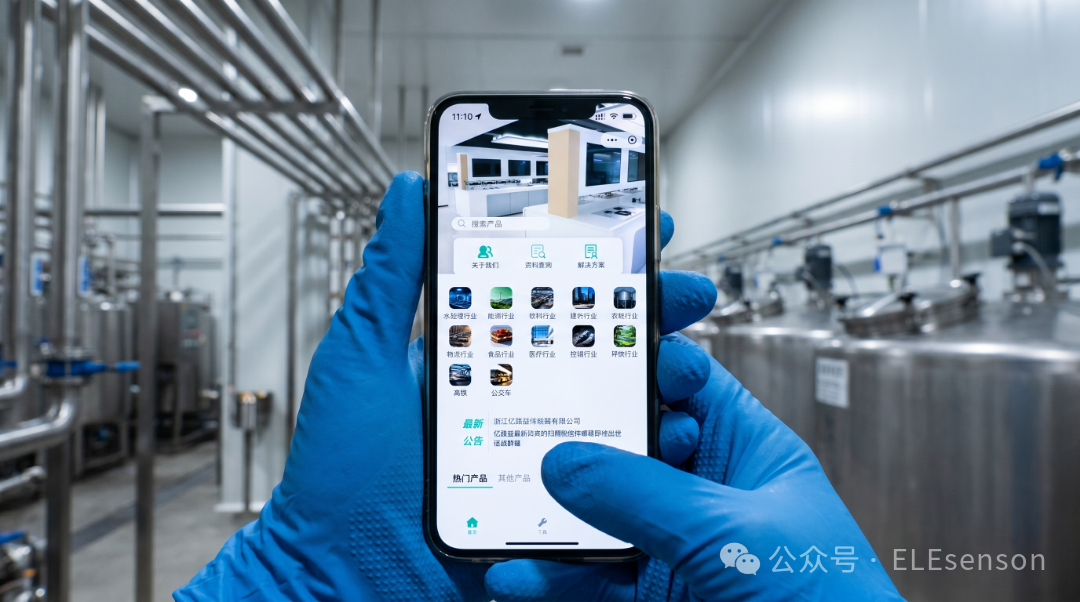
The ESP series revolutionizes traditional commissioning logic. Supporting dedicated mobile Bluetooth one-click tuning, it enables ground-based 3-second fast parameter matching without climbing heights, equipment disassembly, or power downtime. The non-contact debugging method fully adapts to cleanroom dust-free standards and explosion-proof environmental requirements, drastically reducing equipment downtime and eliminating high-altitude operation risks. It greatly simplifies O&M workflows and is widely recognized by frontline maintenance personnel.
02.International-Grade Performance, Ultra-High Cost Performance
Many engineers and purchasers focus on the core performance gap between ELEsenson ESP sensors and international brands. In terms of hardware configuration, anti-interference capability, and long-term operational stability, the ESP series fully matches the technical standards of mainstream imported brands including IFM and Baumer. Meanwhile, it retains the price advantage of domestic equipment, achieving unrivaled overall cost performance in the industry.
|
Comparison Dimension |
Imported Brands (IFM / Balluff) |
Conventional Domestic Level Switches |
ELE ESP Series |
|
Core Detection Technology |
Capacitive / Guided Wave Radar |
Basic Capacitive Detection |
Sweep-Frequency Detection, superior anti-sticking & anti-interference performance |
|
Medium Adaptability |
Requires independent recalibration for different mediums |
Narrow compatible medium range |
Full medium automatic adaptation, plug-and-play after installation |
|
Commissioning Method |
Physical buttons + PC software debugging |
Manual potentiometer knob adjustment |
Mobile Bluetooth one-click wireless tuning |
|
Market Price |
600–1200 USD |
100–200 USD |
180–380 USD, ultra-high cost performance |
|
Delivery Cycle |
6–12 weeks |
1–2 weeks |
In-stock supply, shipped within 3–5 days |
|
Installation Compatibility |
Ordinary standard interface compatibility |
Limited replacement compatibility |
Universal standard interface, direct replacement |
|
After-Sales Service |
Multi-agent layered service, slow response |
Basic telephone consultation |
Factory direct one-on-one full-process technical support |
The ESP series breaks the industry’s long-term binary dilemma of “high price with high stability vs. low price with poor reliability”. It delivers international-grade stable detection performance at domestic affordable prices, paired with exclusive Bluetooth wireless debugging function. Supporting seamless replacement of existing imported and domestic sensors with a complete model matching library, it realizes worry-free model selection and efficient equipment upgrading.
03.Full-Industry Adaptation | Targeted Solutions for Multiple Scenarios
3.1 Environmental Water Treatment (Core Application)
Industry Pain Points: Wastewater tanks feature fluctuating liquid levels and medium concentrations, leading to easy sludge and impurity adhesion on sensor probes. Traditional capacitive sensors generate frequent false alarms, increasing daily O&M workload.
ELE Solution: Adopting non-contact sweep-frequency detection principle, the sensor is not affected by surface sludge and deposits. It automatically adapts to wastewater with different concentrations to ensure long-term stable liquid level monitoring.
Application Effect: After replacement by environmental protection integrators, the monthly false alarm frequency dropped from 3–4 times to zero, effectively reducing on-site rework and maintenance costs.
Target Users: Environmental engineering integrators, wastewater plant O&M teams, water treatment equipment manufacturers.
3.2 Food & Beverage Industry (Bluetooth Function Core Scenario)
Industry Pain Points: After production line CIP cleaning and material switching, traditional sensors require disassembly and recalibration. Line shutdown for debugging causes capacity loss, while tank opening operation violates cleanroom hygiene standards.
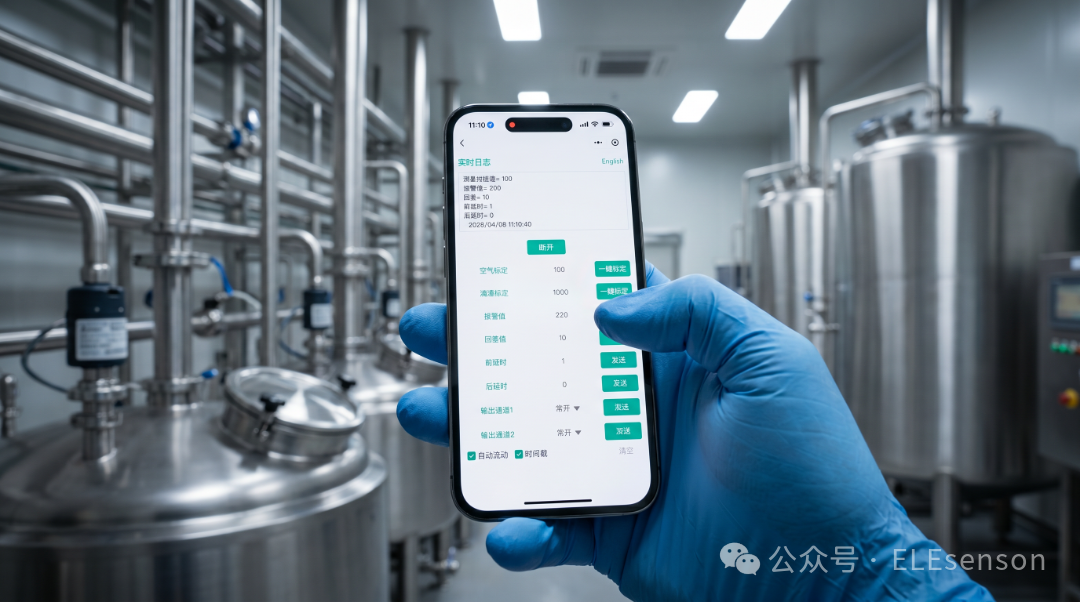
ELE Solution: No equipment disassembly or production shutdown required. Operators complete one-click Bluetooth calibration on the ground after cleaning, ensuring uninterrupted production and compliant clean workshop environment.
User Value: Eliminate capacity loss and safety risks caused by high-altitude disassembly and shutdown debugging, with rapid investment return.
Target Users: Dairy, beverage, condiment and other food processing factory O&M departments.
3.3 Industrial Equipment OEM Supporting
Industry Pain Points: OEM equipment such as air compressors, hydraulic units and purification systems require long-term stable liquid level monitoring, while controlling procurement costs and short delivery cycles to avoid delaying complete machine delivery.
ELE Solution: Universal standardized installation interface, favorable bulk purchase price, 3–5 days rapid delivery, and stable batch quality to meet long-term OEM supporting demands.
Target Users: R&D and procurement teams of air compressor, hydraulic equipment, cooling tower and water purification equipment manufacturers.
3.4 Rail Transit Supporting Scenarios
Industry Pain Points: Locomotive sandbox liquid/sand level detection faces drastic ambient temperature changes, causing severe temperature drift and frequent false alarms for traditional sensors. Disassembly and calibration processes are complicated and time-consuming.
ELE Solution: Sweep-frequency detection is immune to sand and gravel medium interference. Ground Bluetooth parameter adjustment eliminates disassembly operation, effectively solving temperature drift problems and ensuring stable detection data.
Target Users: CRRC supporting component manufacturers, national railway bureau locomotive maintenance depots.
3.5 Power, Steel & Chemical High-Dust Environments
Industry Pain Points: Coal silos, ash hoppers and powder storage silos have severe dust accumulation, which easily blocks traditional sensors, requiring frequent shutdown cleaning and affecting production continuity.
ELE Solution: The sweep-frequency detection principle is not affected by surface dust accumulation, greatly reducing equipment cleaning frequency and adapting to harsh high-dust industrial working conditions.
Target Users: Thermal power plants, steel plants, chemical plant instrument maintenance workshops.
04.Wireless Tuning Upgrades Overall O&M Experience
Bluetooth wireless parameter adjustment is not a simple auxiliary function, but a comprehensive qualitative upgrade of industrial level sensor operation and maintenance modes. Similar to the iteration from traditional button feature phones to smart phones, it subverts the cumbersome logic of traditional debugging.
The ESP series completely eliminates high-altitude climbing, equipment disassembly, repeated debugging and other inefficient operations. A single mobile phone can realize unified debugging and management of all on-site liquid level and material level monitoring points, greatly reducing enterprise labor maintenance costs and improving industrial intelligent operation efficiency.